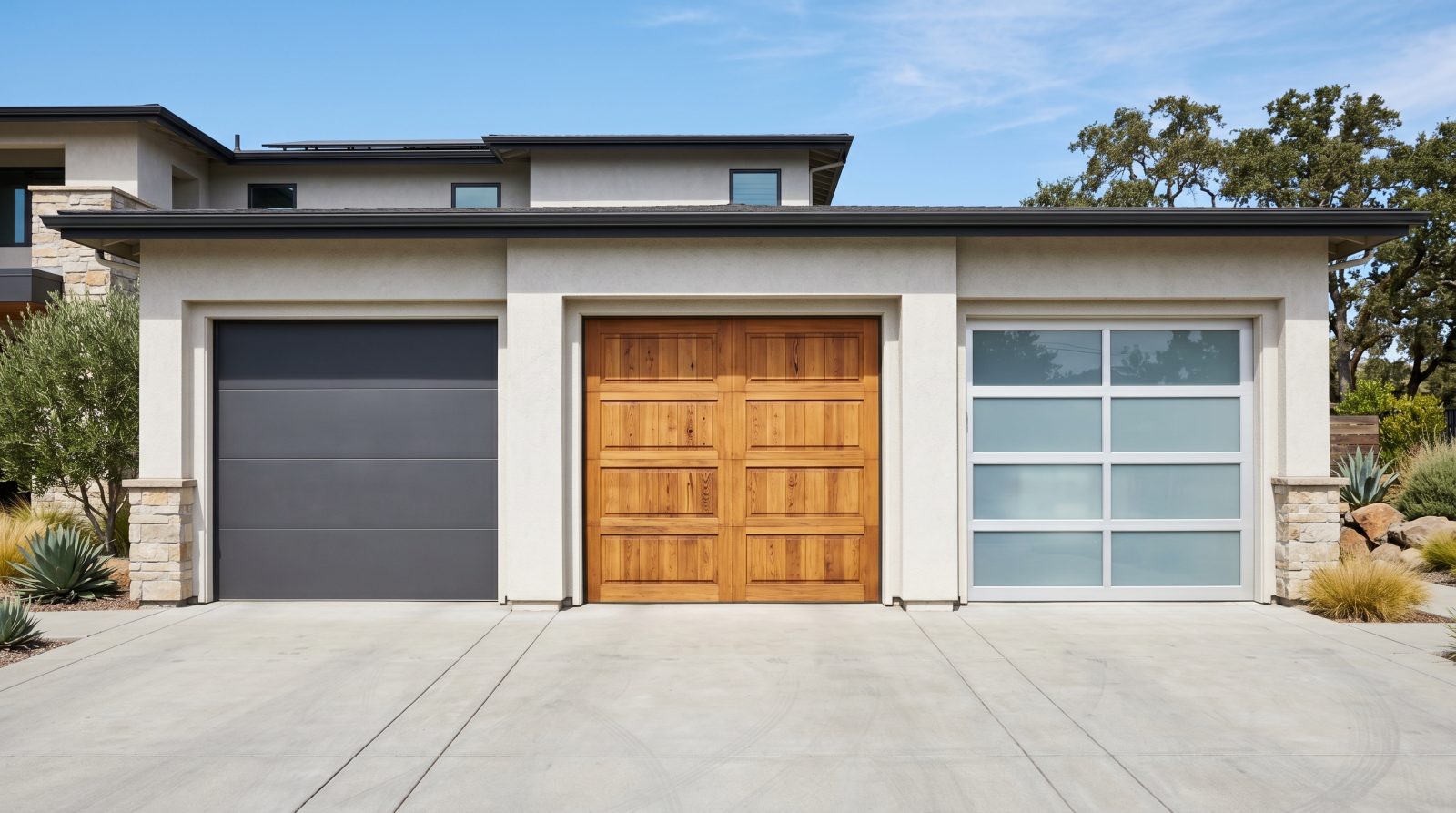
How Material Drives the Price of a Garage Door
When homeowners ask what a garage door costs, they are usually picturing one number. In reality, the installed price is built from several stacked layers, and material sits underneath all of them. The raw door panel is the foundation: a thin single-layer steel section costs a fraction of a triple-layer insulated steel door, and both are far below a real wood or full-view glass-and-aluminum door. Once you pick the material, everything else, insulation, window inserts, hardware grade, finish, and labor, scales up or down from that base.
Two doors of the exact same size can land at very different prices purely on construction. A single-layer (non-insulated) door is one skin of material with nothing behind it. A double-layer adds a polystyrene insulation board. A triple-layer (often called sandwich construction) bonds insulation between two skins, which is quieter, sturdier, and more energy-efficient, and noticeably more expensive. The more layers and the higher the R-value, the higher the cost, regardless of which material you choose.
Door size and configuration matter too. A standard single-car opening is the least expensive to buy and install; a standard two-car door is one wide panel and usually the best value per square foot; oversized RV or carriage-style openings, and any door needing custom-built tracks, sit at the top. Because we are mobile and measure your opening in person, we price the actual door your home needs rather than guessing from a website, which is the most common reason online estimates feel wildly off.
- Panel construction (single-, double-, or triple-layer) often changes price more than the material name itself
- Insulation and R-value add cost but cut noise and heat, which matters in sun-baked inland San Diego garages
- Windows, decorative hardware, and upgraded finishes are add-ons stacked on top of the base door
- Opening size and any custom framing or track work raise both the door and the labor portion
- On-site measuring avoids the surprise gap between an online ballpark and the real installed price
Garage Door Cost by Material: Steel, Aluminum, Wood, Composite & Glass
Below are labeled industry price ranges by material for a typical residential door, installed. These are general ranges, not quotes, and they cover the door and standard installation; they do not include opener replacement, structural repairs, or heavy custom work. Your actual figure depends on size, insulation, windows, finish, and site conditions, which is exactly what an in-person measurement settles.
Steel is the most popular choice in San Diego and across the country because it offers the widest price spread and the best balance of cost, durability, and low maintenance. A bare single-layer steel door for a single-car opening sits at the low end of the market, while a fully insulated triple-layer two-car steel door with windows lands in the mid-to-upper range. Steel takes a baked-on finish well and resists warping, though near the immediate coast you want a quality finish and galvanized or coated hardware to fight salt-air corrosion.
Aluminum and full-view glass doors are the modern, architectural look, aluminum frames with glass or acrylic panels. They are lightweight (easy on the opener and springs) and naturally rust-resistant, which makes aluminum a smart fit for beach-close neighborhoods like Pacific Beach, Ocean Beach, and La Jolla where steel finishes work harder. Full-view glass doors carry a premium because of the glazing and framing, and they sit toward the top of the range. Wood doors, solid wood, wood-clad, or carriage-house styles, deliver the highest-end custom look and the widest price ceiling, but they demand the most upkeep: San Diego's strong sun and coastal humidity mean periodic refinishing to prevent fading, cracking, and warping. Composite and faux-wood doors aim to capture the wood look using engineered or molded materials over an insulated core, giving you the carriage-house appearance with far less maintenance, typically priced between premium steel and real wood.
- Steel (single-layer, single-car): low end of the market, value pick for basic, low-traffic openings
- Steel (insulated, double/triple-layer, two-car): mid-to-upper range; the most common San Diego upgrade
- Aluminum + glass / full-view: upper range; rust-resistant and modern, ideal near the coast
- Composite / faux-wood: mid-to-high range; carriage-house looks with low maintenance
- Real wood / custom carriage: highest range and highest upkeep; refinishing needed for sun and salt air
- All ranges are industry estimates, not quotes, and assume standard installation only
What's Really in the Estimate: Insulation, Windows, Hardware & Labor
The material picks your starting point, but several add-ons decide where you land inside the range. Insulation is the most worthwhile upgrade for many San Diego homes. If your garage is attached, doubles as a gym, workshop, or kids' play space, or faces the afternoon sun in inland areas like El Cajon, Santee, or Chula Vista's eastern edge, an insulated door keeps the space meaningfully cooler and the rest of the house more comfortable. Insulation also makes the door quieter and more rigid, which extends the life of the hardware.
Windows and decorative inserts are pure curb appeal and add to the price per row of glass; tinted or frosted glass costs a bit more but is popular here for privacy and for cutting glare. Hardware grade matters more than people expect: heavier doors and coastal homes benefit from upgraded, corrosion-resistant tracks, rollers, hinges, and springs, which adds to the bill but prevents premature rust and rattling. Spring system choice (standard torsion versus heavier-duty cycle-rated springs) also nudges the number, and a heavier door like solid wood requires stronger springs and sometimes a stronger opener.
Labor is the other half of an installed price. A straightforward swap into existing, sound framing is the cleanest job. Costs rise when the old door must be hauled away, when framing or the header is rotted or out of square, when tracks need to be rebuilt for an unusual opening, or when access is tight. Because we are a mobile operation, our labor reflects coming to you and doing the full job in your driveway, measure, remove, install, balance, and test, in one visit where possible.
- Insulation: best bang-for-buck upgrade for attached, west-facing, or used garages in San Diego heat
- Windows: priced per row; tinted or frosted glass is a small premium and popular for privacy
- Hardware: corrosion-resistant rollers, hinges, and springs are worth it near the coast
- Springs and opener: heavier doors (wood, full-view) may need stronger springs or a stronger opener
- Labor: old-door removal, framing repair, and custom track work add to the installed total
Why San Diego Conditions Change Which Material Pays Off
San Diego is not one climate, it is several within a short drive, and that directly affects which material is the smart spend. Within a few miles of the ocean, in neighborhoods like La Jolla, Pacific Beach, Ocean Beach, Point Loma, and Coronado, salt air is the dominant factor. Salt accelerates corrosion on bare or low-grade steel and on cheap hardware, so coastal homeowners often get more value from naturally rust-resistant aluminum-and-glass doors, or from quality coated steel paired with upgraded, corrosion-resistant rollers and springs. Spending a little more upfront on the right material and hardware here usually costs less over the life of the door.
Inland and East County, places like El Cajon, Santee, Lakeside, and the eastern stretches of Chula Vista and Poway, the story flips to heat and sun. South- and west-facing garage doors take a beating from afternoon sun, which fades finishes and bakes uninsulated metal. Here, an insulated steel or composite door earns its premium by keeping the garage and adjacent rooms cooler and by holding its finish longer. Real wood looks stunning anywhere in the county but pays a maintenance tax everywhere: coastal humidity and inland UV both shorten the time between refinishings.
There is also a regulatory layer. Many newer San Diego communities and master-planned areas (think parts of 4S Ranch, Carmel Valley, Otay Ranch, and Santaluz) have HOA or architectural-review rules that dictate door style, color, and sometimes material. That can rule out certain low-cost options or push you toward a specific composite or wood-look design, which affects your budget before you even pick a finish. As a mobile company, we come out, measure, and talk through the options that fit your microclimate and any HOA guidelines on the spot, so you are budgeting against real choices, not guesses.
- Coastal (La Jolla, PB, OB, Point Loma, Coronado): favor aluminum/glass or coated steel with rust-resistant hardware
- Inland / East County (El Cajon, Santee, Poway): insulated steel or composite pays off against heat and UV
- Wood looks premium countywide but needs regular refinishing for both salt humidity and strong sun
- HOA and architectural rules in newer communities may dictate style, color, or material, shaping the budget
- Mobile, on-site consults match material and price to your specific neighborhood conditions
Repair vs. Replace: Spending Smart on Your Door
Not every problem calls for a new door, and material cost only matters if replacement is actually the right move. Many issues, a broken spring, frayed cables, worn rollers, a bent track, a panel dented by a backed-into bumper, or an opener that quit, are repairs, not full replacements. Repairs are a fraction of a new installed door, and on a door that is otherwise sound and not too old, repair is usually the smarter spend. We will tell you honestly when that is the case rather than upselling a full door you do not need.
Replacement makes more financial sense when the door is failing in several places at once, when sections are rusted through or rotted (common on aging wood doors near the coast), when the door is so old that parts are hard to source, or when you simply want a different material or look for curb appeal and energy savings. In those situations, the material decision in this guide becomes your main budget driver, and choosing the right one for your San Diego microclimate protects that investment.
Because we come to you, a mobile assessment is low-friction: we inspect the door and opening, show you what is failing, and lay out repair-versus-replace honestly with labeled price ranges so you can decide. If replacement is the call, we measure the exact opening, review materials and finishes in your driveway, and give you a real figure for your door. To start, call or request a free quote and we will bring the options to you, no showroom trip required.
- Repair (spring, cable, roller, track, single panel, opener): far cheaper than replacement and often the right call
- Replace when there is widespread failure, rust-through or rot, obsolete parts, or you want a new look or insulation
- On replacement, material becomes the main budget lever, choose for your microclimate to protect the spend
- Mobile assessment means an honest repair-vs-replace recommendation in your driveway, not a sales floor
- Same-day help is available for most common repairs while you weigh a future replacement