The Two Spring Systems: Torsion vs. Extension
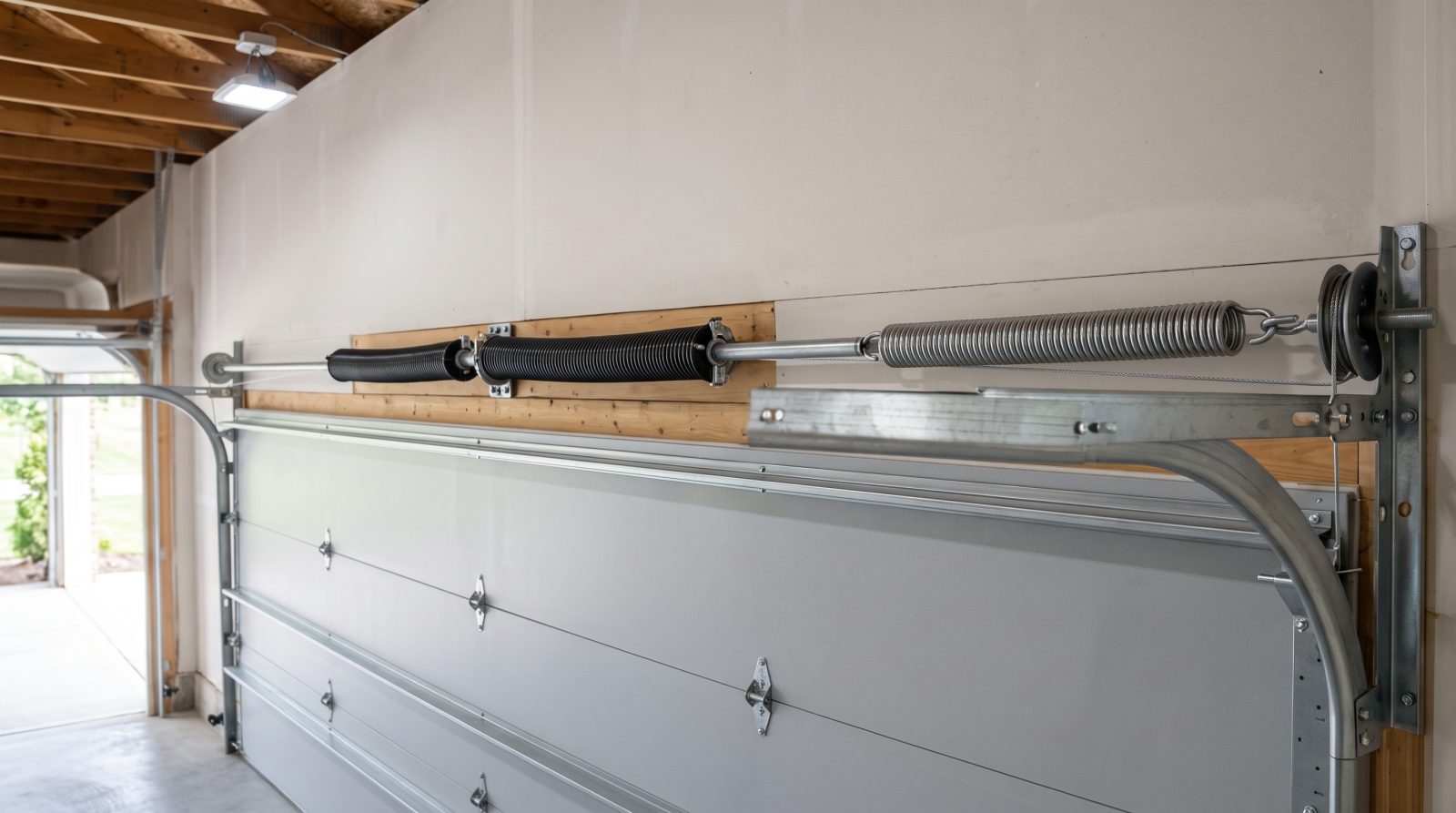
Almost every residential garage door in San Diego uses one of two spring systems. Knowing which one you have helps you understand how your door behaves and what a replacement involves. The quickest way to tell them apart is where the springs sit. Torsion springs mount on a metal shaft along the wall directly above the closed door, parallel to the header. Extension springs run along the horizontal tracks on either side of the door, up near the ceiling, and stretch and contract as the door moves.
Torsion springs work by twisting. When the door comes down, the spring winds up and stores energy; when you open the door, it unwinds and releases that energy to lift the weight. Because the force is balanced through a central shaft and drums, torsion systems raise and lower the door in a smooth, controlled motion. They are the more modern standard and are what most reputable installers fit on new doors today.
Extension springs work by stretching. As the door closes, the springs extend and store tension; as it opens, they contract and pull the door up. They are common on older homes and on lighter single-car doors throughout San Diego's mid-century neighborhoods. Extension systems are simpler and cheaper, but because each side operates somewhat independently, they can pull unevenly and put a door slightly out of balance over time.
- Torsion springs: mounted on a shaft above the door, twist to store energy, smoother and more durable.
- Extension springs: mounted along the side tracks, stretch to store energy, simpler and lower cost.
- Quick check: look above the closed door (torsion) versus along the upper side tracks (extension).
- Some heavier or wider doors use dual springs of either type for balanced lifting.
How Each Type Performs: Lifespan, Safety, and Noise
Spring life is measured in cycles, where one cycle is a full open-and-close. Standard residential springs are commonly rated in the 10,000-cycle range, which can translate to roughly seven to twelve years of typical use, though heavy daily use, like a family using the garage as the main entrance, burns through cycles faster. Higher-cycle springs rated at 20,000 or more are available and are worth considering if your door runs many times a day. Coastal and bayfront areas of San Diego add another factor: salt air accelerates corrosion on uncoated steel, and rust shortens spring life and can cause a spring to fail earlier than its cycle rating suggests.
On lifespan, torsion springs generally last longer and stay better balanced than extension springs of the same age, which is a big reason they have become the standard. On safety, the difference is significant. When an extension spring breaks under full tension, the spring and its hardware can become a projectile unless safety cables are run through the springs to contain them. If your door has extension springs and no safety cables threaded through them, that is something a technician should address. Torsion springs, by contrast, are captured on the shaft, so a break tends to stay contained, though the stored energy is still extremely dangerous to anyone working on it untrained.
Noise is the everyday difference most homeowners notice. Extension springs, with more loose moving parts, tend to be louder and can squeak or rattle as they stretch. Torsion systems run quieter and more evenly. If a door has gotten noticeably noisier or jerkier, that can be an early sign the springs are wearing, fatigued, or in need of lubrication and adjustment before they fail outright.
- Spring life is rated in cycles (open + close); standard springs often run roughly 7-12 years of typical use.
- High-cycle springs (20,000+) suit doors that open many times a day.
- San Diego coastal salt air speeds up rust and can shorten spring life.
- Extension springs need safety cables to contain a break; torsion springs are captured on the shaft.
- A door that has become loud, jerky, or slow may have fatiguing springs.
Signs Your Springs Are Failing
Springs rarely fail without warning, but the warning signs are easy to miss if you do not know what to look for. The most unmistakable sign is a loud bang from the garage, often mistaken for something falling. That sound is usually a torsion or extension spring snapping under tension. After a break, the door typically becomes very heavy or will not open at all, and the opener may strain, hum, or reverse because it was never designed to lift the full weight of the door by itself.
A visible gap in a torsion spring is a clear tell. Healthy torsion springs are tightly wound coils; if you see a two-to-three-inch separation in the coil, the spring is broken even if the door still partly moves on a second spring. For extension springs, look for a stretched, sagging, or detached spring along the side track. Other clues include a door that opens crooked or hangs at an angle, jerky movement, or a door that slams down faster than it should because there is no longer enough spring tension to control the descent.
If you suspect a broken spring, the safest move is to stop using the door and leave it where it is. Do not repeatedly hit the opener button trying to force it, which can damage the opener, bend the tracks, or fray cables. A door with a broken spring is unbalanced and can drop unexpectedly. Because San Diego Garage Door is mobile, we can come to your home across the San Diego area, diagnose the failure on-site, and replace the spring the same day in most cases.
- A sudden loud bang from the garage is the classic sound of a broken spring.
- The door suddenly feels very heavy, won't open, or the opener strains and reverses.
- A visible 2-3 inch gap in a torsion coil means that spring is broken.
- Stretched, sagging, or detached extension springs along the side tracks.
- The door opens crooked, moves jerkily, or slams shut too fast.
Why Spring Replacement Is Not a DIY Job
Garage door springs hold an enormous amount of stored mechanical energy, and that energy does not go away just because the door is closed. Torsion springs in particular are wound to a precise tension and must be unwound and rewound with proper winding bars. A slip or the wrong tool can cause the bars or spring to whip violently. This is consistently one of the repairs that sends untrained homeowners to the emergency room, and it is why professional replacement is strongly recommended even by people comfortable with most home projects.
Beyond the immediate danger, getting the spring right is a precision job. The replacement must match the door's weight, with the correct wire gauge, coil length, inside diameter, and wind direction. An undersized spring will fail prematurely and overwork the opener; an oversized one will leave the door unbalanced and harder to control. On torsion systems, the final tension has to be set so the door stays put at any height and lifts smoothly. On extension systems, both sides need to be balanced and safety cables installed or verified so a future break stays contained.
There is also the matter of doing it once and doing it right. When one spring on a two-spring door breaks, the other is usually close behind, so replacing both at the same time is the standard recommendation that saves a second service call. A proper visit also includes checking the cables, rollers, drums, and door balance, because a worn part elsewhere is often what stressed the spring in the first place. Our technicians arrive with the right springs and tools, work safely, and confirm the whole system is balanced before we leave.
- Springs store huge amounts of energy even when the door is closed.
- Torsion springs require winding bars and exact tension; mistakes cause serious injuries.
- The right spring must match wire gauge, length, diameter, and wind direction to the door's weight.
- Replacing both springs at once on a two-spring door avoids a quick second failure.
- A good visit also checks cables, rollers, drums, and overall door balance.
Local San Diego Realities and What Replacement Involves
San Diego's climate is gentler on garage doors than many parts of the country, but it has its own challenges. The big one is coastal corrosion. Homes in and around La Jolla, Pacific Beach, Ocean Beach, Point Loma, Coronado, Imperial Beach, and the bay-facing communities sit in salt-laden air that rusts springs, cables, and hardware faster than inland areas like El Cajon, Santee, or Poway. Salt-air exposure is a leading reason coastal doors need spring and hardware service sooner, so coated or galvanized springs and regular lubrication make a real difference near the water.
Inland and East County homeowners face the opposite extreme in summer, where attached garages can get very hot and the daily temperature swings cause metal to expand and contract. Combined with the way many San Diego families use the garage as their main door, several open-and-close cycles a day, that adds up over the years. Knowing whether you have torsion or extension springs, and roughly how old they are, helps you plan ahead rather than getting caught with a dead door on a workday morning.
As a labeled industry range, residential spring replacement commonly falls somewhere in the low-to-mid hundreds of dollars depending on the spring type, whether you replace one or both, the wire gauge and cycle rating, and the condition of the surrounding hardware. That is a general range, not a quote, because the right number depends on your specific door. Because we are fully mobile, there is no storefront to drive to; we bring the parts and tools to your driveway, measure your door, and give you a clear price before any work starts. Call or request a free quote and we will come out, diagnose the springs on-site, and get your door running safely and quietly again.
- Coastal San Diego (La Jolla, PB, OB, Point Loma, Coronado, Imperial Beach) sees faster salt-air corrosion of springs and hardware.
- Inland and East County (El Cajon, Santee, Poway) deal with summer heat and big temperature swings.
- Galvanized or coated springs plus regular lubrication help near the coast.
- Cost is a labeled industry range (low-to-mid hundreds, varies by type, gauge, and one vs. two springs), not a quote.
- Fully mobile: we bring parts and tools to your home, measure on-site, and price before any work begins.