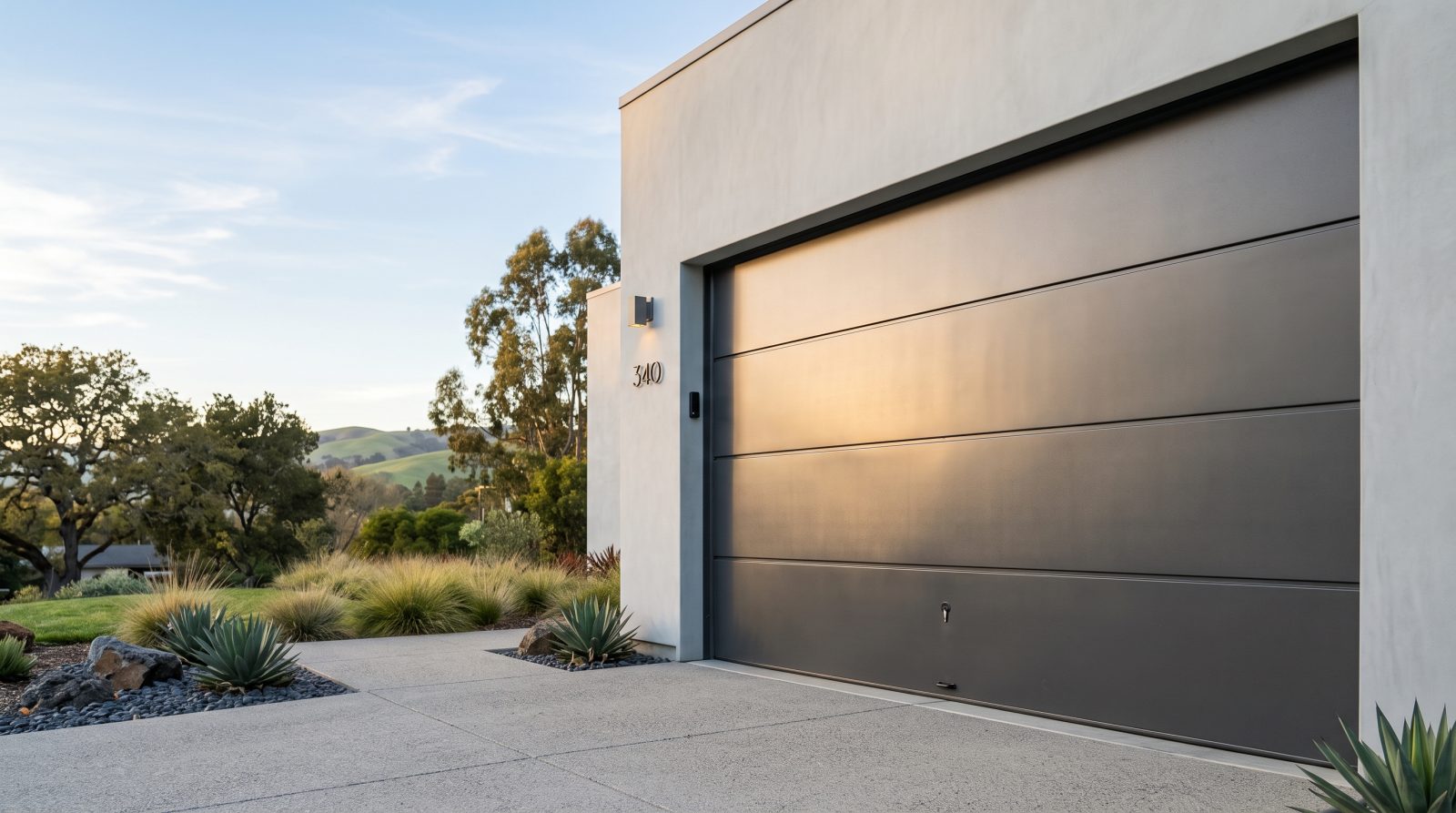
Why Steel Is the Default Choice for San Diego Garages
Steel doors dominate the local market because they solve the problems San Diego homeowners actually have. They don't crack in the inland heat the way some older fiberglass panels can, they don't swell or rot like wood, and a good factory finish shrugs off our intense UV far longer than a painted wood door. For most homes from Chula Vista up to Oceanside, a steel door is the practical sweet spot between cost, durability, and appearance.
The other reason steel wins here is versatility. Steel can be left as a flat contemporary panel, stamped to mimic raised-panel carriage-house wood, or finished in a woodgrain texture that reads as real wood from the curb without the upkeep. That range matters in a county with everything from mid-century ranch homes in Kensington to newer HOA-governed tracts in 4S Ranch and Otay Ranch, where the door has to match a required palette.
- Holds its shape in inland heat where some other materials can warp or fade
- Won't rot, swell, or attract pests the way untreated wood can
- Available in flat modern, raised-panel, and woodgrain looks to fit nearly any San Diego neighborhood
- Factory baked-on finishes resist Southern California UV far better than a hand-painted door
- Generally the best value per dollar for long-term durability
Understanding Steel Gauge, Layers, and Real Durability
Not all steel doors are equal, and the differences are easy to miss in a showroom photo. The two things that actually drive durability are the steel gauge (its thickness) and how many layers the door is built from. With gauge, a lower number means thicker, stronger steel: a 24-gauge door is noticeably more dent-resistant than a thin 27- or 28-gauge builder-grade door. If you've got kids with basketballs, a tight driveway, or you simply want a door that still looks good in fifteen years, thicker steel is worth it.
Construction layers matter just as much. A single-layer door is one skin of steel with nothing behind it; it's the cheapest option and the loudest, with zero insulation. A two-layer door adds insulation bonded to the back. A three-layer (sandwich) door places insulation between two steel skins, giving you the strongest, quietest, best-insulated build. For an attached garage that shares a wall with living space, or any garage used as a gym, office, or shop, the three-layer construction is usually the one that pays you back in comfort and quiet.
- Gauge: lower number = thicker, stronger steel (24-gauge beats 28-gauge for dent resistance)
- Single-layer: steel only, lowest cost, no insulation, more prone to dents and noise
- Two-layer: steel plus backed insulation, a solid mid-range upgrade
- Three-layer (sandwich): steel-insulation-steel, the strongest, quietest, most insulated build
- Heavier insulated doors are also more rigid, so they flex and rattle less in wind
Insulation: What R-Value Actually Does in Our Climate
San Diego doesn't have brutal winters, so homeowners sometimes assume an insulated door is wasted money here. In practice it's often the opposite. Inland communities like El Cajon, Santee, Poway, and Escondido can run well into the 90s and beyond in summer, and an uninsulated steel door turns a south- or west-facing garage into an oven that bleeds heat into the house. An insulated door keeps that garage and the rooms next to it meaningfully cooler.
Insulation is measured in R-value, where a higher number means better resistance to heat transfer. Single-layer doors offer essentially no R-value. Two- and three-layer doors using polystyrene or denser polyurethane foam reach much higher numbers, with polyurethane generally outperforming polystyrene at the same thickness while also stiffening the door. If your garage is attached, used as a workspace, or faces the afternoon sun, insulation is one of the highest-value upgrades you can make. There's a quieter benefit too: an insulated, well-built steel door dampens street noise and the door's own operating sound, which neighbors and anyone with a bedroom over the garage will appreciate.
- Higher R-value = better at blocking heat transfer into your garage and home
- Polyurethane foam typically out-insulates polystyrene and adds rigidity
- Biggest payoff on attached garages and south/west-facing doors in inland heat
- Insulated doors run noticeably quieter, a real plus for living space above the garage
- Helps keep a garage gym, office, or workshop usable through summer
Coastal Corrosion: Protecting Steel Near the Water
This is the one area where San Diego's geography genuinely changes the recommendation. Homes in the coastal zone, think Ocean Beach, Pacific Beach, Imperial Beach, Coronado, Cardiff, and Encinitas, sit in constant salt-laden marine air. That salt is hard on steel, and a cheap door with a thin finish or exposed fasteners can start showing surface rust far sooner than the same door a few miles inland.
The fix isn't to avoid steel; it's to specify it correctly. For near-water homes we steer customers toward doors with heavier galvanized coatings, robust multi-stage primer and topcoat finishes, and corrosion-resistant hardware, springs, and fasteners, since the hardware often rusts before the panels do. A door built and finished for a coastal environment, then kept lightly maintained, will serve a beach-area home for many years. When we quote a coastal property, we'll flag exactly which finish and hardware choices matter so you're not paying for the wrong door.
- Coastal salt air accelerates corrosion on under-built steel doors and cheap hardware
- Specify heavier galvanizing plus a strong primer-and-topcoat finish near the water
- Corrosion-resistant springs, rollers, hinges, and fasteners matter as much as the panels
- An occasional fresh-water rinse helps clear salt buildup from a beach-area door
- We flag the right coastal-grade options when quoting near-water homes
What Steel Garage Doors Cost in San Diego
Pricing depends on size, gauge, number of layers, insulation, finish, and any windows or decorative hardware, so the honest answer is a range rather than a single figure. As a general industry guide, a basic single-layer steel door for a standard single-car opening typically falls in the lower hundreds of dollars for the door itself, while insulated two- and three-layer doors, larger double-car sizes, woodgrain or carriage-house styling, and windows push the total higher into the four-figure range. Installation, haul-away of the old door, and any spring or opener work are separate line items.
A few San Diego-specific factors can affect your number: a coastal-grade finish and hardware package costs more than a standard build, a heavier insulated door may call for a stronger spring system and sometimes an opener better suited to the added weight, and double-wide or oversized openings common in newer tract homes use more material. Rather than guess, we measure your opening in person, confirm headroom and side clearance, and give you a clear written quote with the options laid out so you can choose the right door instead of the most expensive one. The estimate is free, and you're never locked in.
- Single-layer, single-car steel door: typically lowest cost (industry range, not a quote)
- Insulated two/three-layer, double-car, woodgrain, or windowed doors: higher cost
- Coastal-grade finish and hardware adds cost but greatly extends life near the water
- Heavier insulated doors may need a matched spring system or a stronger opener
- We measure on-site and provide a clear, no-obligation written quote before any work