What Garage Door Safety Sensors Actually Are
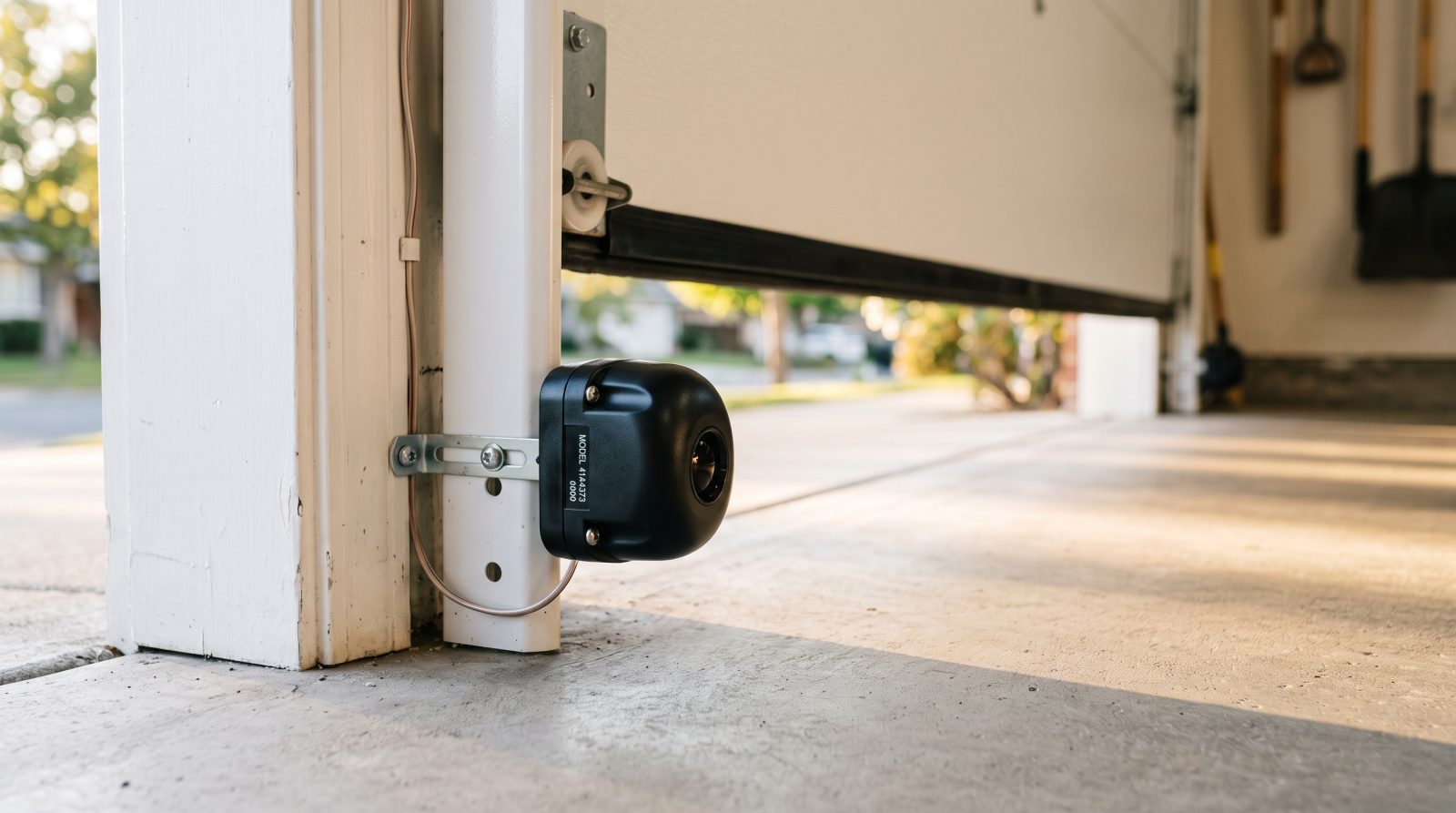
Garage door safety sensors are a matched pair of photo-electric eyes mounted on the left and right vertical tracks, typically about four to six inches off the garage floor. One side is the sending unit, which projects a continuous, invisible infrared beam across the door opening. The other side is the receiving unit, which 'listens' for that beam. As long as the receiver sees an uninterrupted beam, the system knows the path is clear and allows the door to close. The instant something breaks the beam, a child, a pet, a car bumper, or a bag of groceries, the opener refuses to lower the door or immediately reverses it back up.
This technology has been federally required on residential garage door openers manufactured in the United States since 1993, after a tragic history of entrapment injuries involving the heaviest moving object in most homes. A standard double garage door can weigh well over a hundred pounds, and it descends with real force. The photo-eyes are the non-contact safeguard that stops that weight before it ever touches a person or object. They work alongside a second safety feature, mechanical force reversal, but the photo-eyes are the first and fastest line of defense.
Each sensor usually has a small indicator light, an LED on the housing that tells a trained eye exactly what's going on. On most brands, a steady glowing light on both sensors means they are powered and aligned. A flickering, dim, or completely dark light on one side is the tell-tale sign that the pair has lost its line of sight to each other, which is the single most common reason a healthy door suddenly stops closing.
- Two units: a sending eye and a receiving eye, one on each side of the opening
- Mounted low, usually four to six inches above the garage floor
- Project an invisible infrared beam across the door's path
- Federally required on U.S. residential openers since 1993
- Small LED indicator lights reveal power and alignment status at a glance
Why They Matter More Than Any Other Part
It's easy to dismiss the photo-eyes as a minor inconvenience, especially when a misaligned sensor is keeping you from leaving for work on time. But these sensors are the reason a garage door is one of the safest large appliances in your home rather than one of the most dangerous. They exist specifically to protect small children and pets, who are exactly the right height to be in the beam's path and exactly the people least likely to move out of the way of a descending door.
Because they are a safety device, the responsible fix is never to bypass or disable them. We occasionally meet San Diego homeowners who, frustrated by a sensor that keeps reversing the door, have been tempted to wire around the eyes or tape them facing each other in mid-air so the door 'just closes.' That defeats the entire purpose and removes the protection the system was designed and legally required to provide. A door that closes without working sensors is a door that will close on whatever, or whoever, is in its way.
There is also a practical, property-protection angle. A working sensor pair stops the door before it crushes a bicycle left in the threshold, a car parked too far forward, or a trash can rolled into the opening on a windy day. In a region where many homes use the garage as the primary entrance and a catch-all for surfboards, beach gear, and bikes, that low beam is constantly doing quiet, useful work you never notice, until it stops.
- Primary protection for children and pets at the exact height of the beam
- Should never be bypassed, disabled, or 'taped facing the air' to force a close
- Also protects vehicles, bikes, and gear left in the door's path
- Federally mandated, so a working pair is part of a code-compliant door
The Warning Signs of a Sensor Problem
Sensor trouble has a very recognizable signature, and learning to read it saves you guesswork. The classic symptom is a door that closes part way and then reverses back to fully open, often accompanied by the opener lights flashing several times in a row. That flashing is not random; on most openers it is a deliberate diagnostic code telling you the safety circuit was interrupted. The door is doing exactly what it's supposed to do: refusing to close because it doesn't believe the path is clear.
A second common pattern is a door that won't close at all from the wall button or remote but will close if you press and hold the wall button continuously. Many openers include a 'hold-to-close' override that bypasses the photo-eye for that single operation, precisely so you can get the door shut in an emergency. If your door only closes while you keep your finger pinned on the button, that is a near-certain sign the sensors, not the motor or the springs, are the problem.
Other clues include a sensor light that is off or blinking when its partner is solid, visible dirt or spider webs over the lenses, a sensor hanging loose from its bracket, or a recent event you can connect the dots to, someone bumped the track, a heavy box slid into the corner, or a sprinkler has been misting the lens every morning. In San Diego garages, sun glare through an open door at certain times of day and salt-air corrosion on coastal brackets are two local realities that can also confuse or loosen a sensor over time.
- Door starts to close, then reverses to fully open
- Opener lights flash a repeating pattern when you try to close
- Door only closes if you press and hold the wall button
- One sensor light is off or blinking while the other is solid
- Lenses are dusty, fogged, web-covered, or hit by sprinkler overspray
- A bracket is loose, bent, or knocked out of position
What You Can Safely Check Yourself
Before anything else, look at the two sensor lights with the door open. Walk to each eye and note whether the LED is steady, dim, blinking, or dark. A steady light on both sides usually means alignment is fine and the issue lies elsewhere; a dark or blinking light points straight at that sensor. Note that the sending and receiving units sometimes use different colored lights by design, so a different color on each side is normal, what matters is whether each light is steady.
Next, gently clean both lenses. Over months, dust, pollen, cobwebs, and the fine grit that drifts into open garages can build a film thick enough to weaken the beam. Wipe each lens with a soft, dry or barely damp microfiber cloth, never a harsh solvent or an abrasive pad that could scratch the optic. This single step resolves a surprising number of 'broken' sensors with zero cost. While you're down there, make sure nothing is physically blocking the beam: a leaning broom, a stored bin, a coiled hose, or a pet bed pushed too close to the track.
Finally, you can check for obvious misalignment by sight. The two eyes need to point directly at each other across the opening. If one is visibly drooping, twisted, or has been bumped so its bracket sits at an angle, that's your answer. Some homeowners are comfortable loosening the wing nut on a bracket and nudging the sensor until the indicator light goes solid, then re-tightening. If you try this, move in tiny increments and stop the moment the light steadies. What we ask you not to do is force the door closed with the hold-button override as a permanent habit, or attempt to rewire or open the sensor housings, that crosses from safe homeowner maintenance into work better left to a technician with the right parts and testing tools.
- Check both LED lights with the door open: steady is good, dark or blinking is the clue
- Clean each lens with a soft microfiber cloth, no harsh solvents or abrasives
- Clear anything leaning into or blocking the beam path
- Sight-check that both eyes point directly at each other
- Nudge a loose bracket in tiny moves until the light goes solid, then retighten
- Do not permanently rely on the hold-to-close override or open the housings
When to Call a Mobile Garage Door Pro
Plenty of sensor issues come down to a quick clean or a small nudge, and we're glad when a homeowner solves it in five minutes. But some symptoms point to problems that need diagnostic tools and replacement parts on hand. If you've cleaned the lenses, cleared the path, and confirmed the brackets look aligned, and a sensor light still won't hold steady, the trouble is usually deeper: a frayed or pinched sensor wire, corrosion on the terminals, a failed sensor unit, water intrusion in a coastal garage, or a fault on the opener's logic board.
This is where a mobile service genuinely helps. Because we come to you anywhere in the San Diego area, a technician can test the actual voltage reaching each sensor, inspect the full wire run from the eye back to the opener head, swap in a known-good sensor to isolate the fault, and confirm the safety reversal works correctly before leaving, all in your own driveway. Diagnosing a sensor by phone is guesswork; diagnosing it with the door in front of you is a fix. Garage door safety sensor repairs are generally one of the more affordable service visits compared to springs or panels; actual costs vary by the parts involved and are best confirmed after a look, but sensor work typically falls at the lighter end of the industry range. We'll always tell you what we find before any work begins.
It's also worth a professional look any time the door has been physically struck, has gone through a power surge, or behaves erratically in ways that don't match a simple alignment problem, for example, reversing at random with clean, aligned, well-lit sensors. Those patterns can indicate an opener or wiring fault that a sensor swap alone won't cure, and it's better to know that for certain than to keep chasing the wrong part. If you're unsure, reach out and request a free quote, we'd rather take a quick look than have you living with a door that won't safely close.
- Lights still won't hold steady after cleaning, clearing, and aligning
- A sensor wire looks frayed, pinched, corroded, or water-damaged
- The door reverses randomly even with clean, aligned, well-lit sensors
- The system was struck, flooded, or hit by a power surge
- You want the safety reversal tested and verified, not just patched
- Mobile service means the full diagnosis and the fix happen right in your driveway