First, Figure Out How It Won't Open
"Won't open" describes a dozen different problems, and the symptom tells you almost everything about the cause. Before you touch a single thing, stand back and watch what the door actually does when you press the button or pull the handle. The way it fails is your fastest diagnostic tool.
Pay attention to sound, movement, and the opener's behavior. A door that does nothing at all points one direction; a door that hums, strains, or moves an inch and stops points somewhere else entirely. Take ten seconds to categorize it and you'll skip half the wrong rabbit holes.
- Opener does nothing, no sound, no lights: likely a power or remote/wiring issue, not the door itself.
- Opener hums or clicks but the door doesn't move: possibly a stripped opener gear, broken spring, or the door is jammed.
- Door rises a few inches then reverses or stops: usually a safety sensor, travel-limit, or force-setting problem.
- Loud bang heard earlier, now nothing: classic broken torsion spring, do not force it.
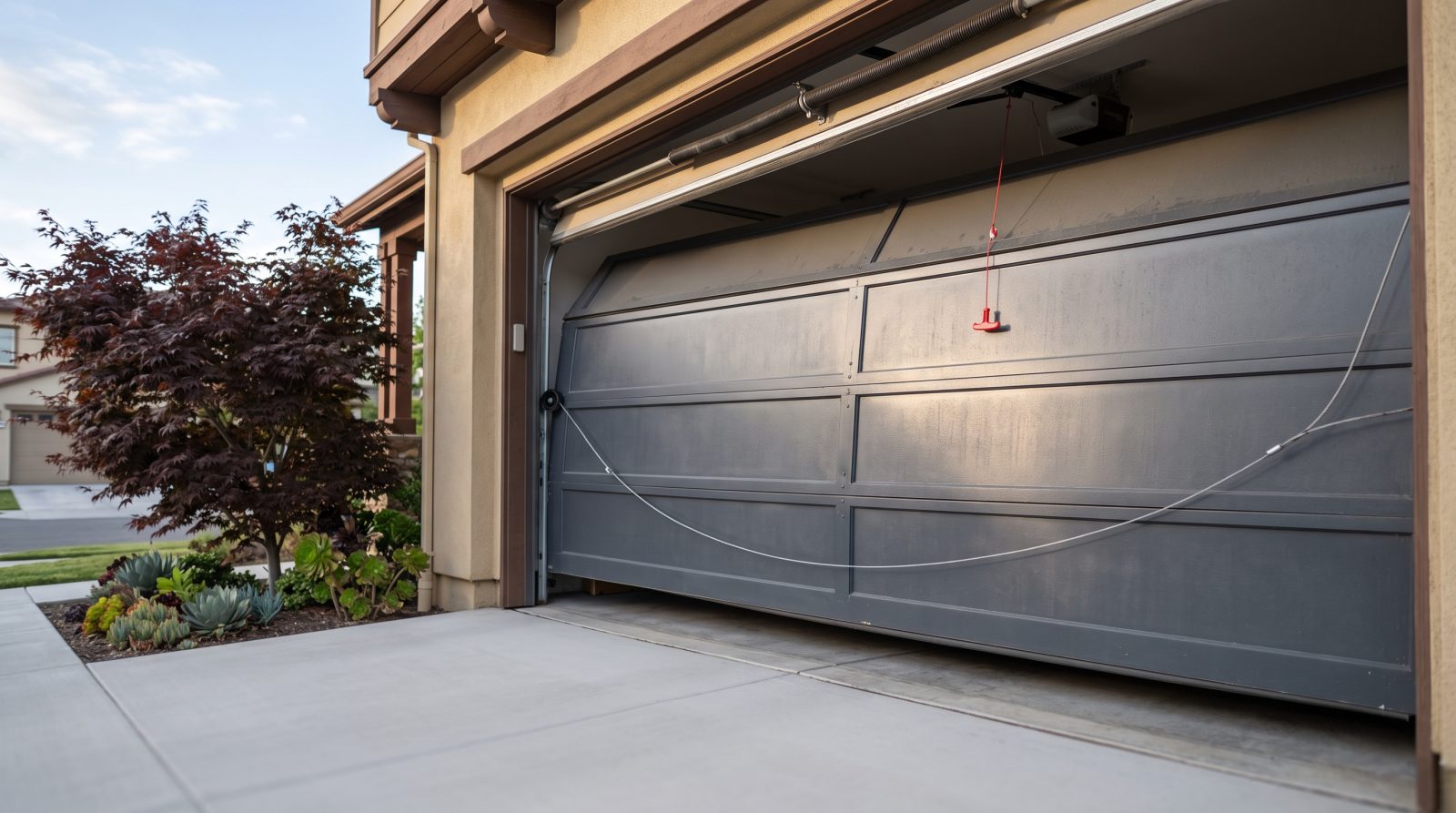
- Door is crooked, sagging on one side, or a cable is hanging loose: a cable or drum failure, stop immediately.
- Only the remote fails but the wall button works: a remote, antenna, or interference issue, not a mechanical one.
Safe Checks You Can Do Yourself From the Driveway
Plenty of "won't open" calls turn out to be something simple, and there's no harm in ruling those out first. These checks are safe because they don't involve the high-tension spring system, which is the one part of a garage door that can injure you. Work through them in order and you may solve it on your own.
If you have a power outage in your area, which San Diego sees during high-wind Santa Ana events and grid maintenance, the opener simply has no power, and the fix is the manual release rope, covered below. Heat is another local factor: a garage that bakes in inland summer sun can swell weatherstripping and stiffen lubrication, making a marginal door finally refuse to budge.
- Confirm power: check that the opener is plugged in and the outlet has power (test it with a phone charger or lamp).
- Check the breaker for the garage circuit, it may have tripped, especially after a power surge.
- Look for a vacation/lock button on the wall console, an accidental press disables the remotes.
- Replace the remote battery and try the hardwired wall button, this isolates remote problems from door problems.
- Clean the two photo-eye safety sensors near the floor and make sure they face each other, sun glare and spider webs are common San Diego culprits.
- Look down the tracks for an obvious obstruction, a stored item, a bike, or debris leaning against the door.
- Check that the manual lock bar on older doors isn't engaged, the door physically cannot rise if it is.
Using the Manual Release the Right Way
Every automatic garage door has a manual release, the red cord with a handle hanging from the trolley near the center of the door. It disconnects the door from the opener so you can lift it by hand, which is how you get your car out during a power outage or opener failure. Used correctly it's perfectly safe. Used on a door with a broken spring, it can drop a heavy panel onto whatever is beneath it.
The single most important rule: only pull the manual release when the door is fully closed. If you pull it while the door is partway up and a spring is broken, the door can slam down with enormous force. With the door down, pulling the cord lets you test something crucial, whether the door lifts smoothly by hand.
- Make sure the door is fully closed before pulling the red release cord.
- Lift the door by hand a foot or two: a healthy door feels light and stays where you leave it.
- If it feels extremely heavy, slams back down, or won't budge, the spring system has failed, stop and call a pro.
- To re-engage, pull the cord toward the door or run the opener until the trolley re-latches (varies by model).
- Never leave a door disconnected and partly open, especially with kids or pets around.
The Dangerous Stuff: When to Stop and Call a Pro
Some garage door problems are not DIY territory, no matter how handy you are. The torsion and extension springs that counterbalance your door are under extreme tension, enough to cause serious injury, and the cables that work with them are just as unforgiving. These components are the leading reason a door suddenly "won't open," and they are the leading reason garage door work sends people to the ER.
A broken spring is one of the most common serious failures. You'll often hear a loud bang, sometimes hours before the door fails, and then the opener strains against a weight it was never meant to lift alone. Forcing it can burn out the opener motor on top of the original problem. Cables that have frayed, jumped the drum, or snapped leave the door crooked and unstable. None of these should be tackled with household tools.
- Broken or stretched springs: high-tension components that require proper tools and training, replace in pairs.
- Snapped, frayed, or off-track cables: the door can fall or bind, do not operate it.
- Door off its tracks or rollers out of alignment: forcing it bends the track and multiplies the repair.
- Bent or buckled panels after hitting a vehicle: structural and often spring-related.
- A stripped opener drive gear or burned-out motor: needs parts and adjustment, not muscle.
- Anything where the door is partly open and won't move: secure the area and wait for a technician.
Why a Mobile San Diego Service Makes Sense for a Stuck Door
A garage door that won't open is, by definition, hard to take anywhere, your car may even be trapped inside. That's exactly why a mobile, we-come-to-you service fits this problem so well. Instead of arranging a tow or living with a gaping or jammed door, you get a technician at your driveway with the springs, cables, rollers, and opener parts needed to diagnose and fix it on the spot.
San Diego's geography makes this even more practical. The county is spread across coastal communities, inland valleys, and hillside neighborhoods, and a fully stocked mobile van reaches all of them, from Point Loma and Pacific Beach to Santee, Poway, and the South Bay. Coastal homes deal with salt-air corrosion on cables and hardware, while inland areas like El Cajon and Escondido see heat and dust that dry out lubrication and wear rollers faster, different realities that a local tech can read at a glance.
On cost, expect honesty rather than a guess over the phone: a broken-spring replacement, a cable repair, an opener gear rebuild, and a full opener replacement each sit in very different industry price ranges, and the actual cause should be confirmed before any number is quoted. The fastest path back to a working door is a same-day mobile visit, an accurate diagnosis, and the right parts on the truck.
- We come to you, no need to move a trapped car or a heavy, unsafe door.
- Vans carry common springs, cables, rollers, and opener parts for same-day fixes.
- Local techs account for coastal salt corrosion vs. inland heat-and-dust wear.
- Honest, labeled cost ranges confirmed after diagnosis, not a blind phone quote.
- Service across the county, coastal, inland, and hillside neighborhoods alike.