The Big Picture: Why a Garage Door Is Really a Counterbalance Machine
The single most important thing to understand about a garage door is that the motor is not what lifts it. A typical sectional residential door weighs between roughly 130 and 350 pounds, depending on whether it is a single-layer steel door, an insulated double, or a solid wood custom build common in older La Jolla and Mission Hills homes. No standard garage door opener is strong enough to hoist that much weight on its own, and it is not designed to. The real lifting is done by a spring system that stores and releases energy, counterbalancing the door's weight so that it becomes almost weightless to move.
When the system is balanced correctly, you can lift the door by hand with one finger and it will float in place at any height. The opener simply gives that already-counterbalanced door a gentle push or pull. This is why a properly tuned door is quiet and smooth, and why a door with a failing spring suddenly feels brutally heavy or slams down: the counterbalance is gone, and now the opener (or your back) is fighting the door's full dead weight. Once you grasp this counterbalance principle, almost every symptom you will ever experience starts to make sense.
- The spring system carries the weight; the opener only guides the door
- A balanced door floats in place at any height when lifted by hand
- A door that suddenly feels heavy or crashes down usually signals a spring problem, not an opener problem
- Working on a charged spring is the most dangerous part of the system and is best left to a trained technician
The Spring System: Torsion vs. Extension
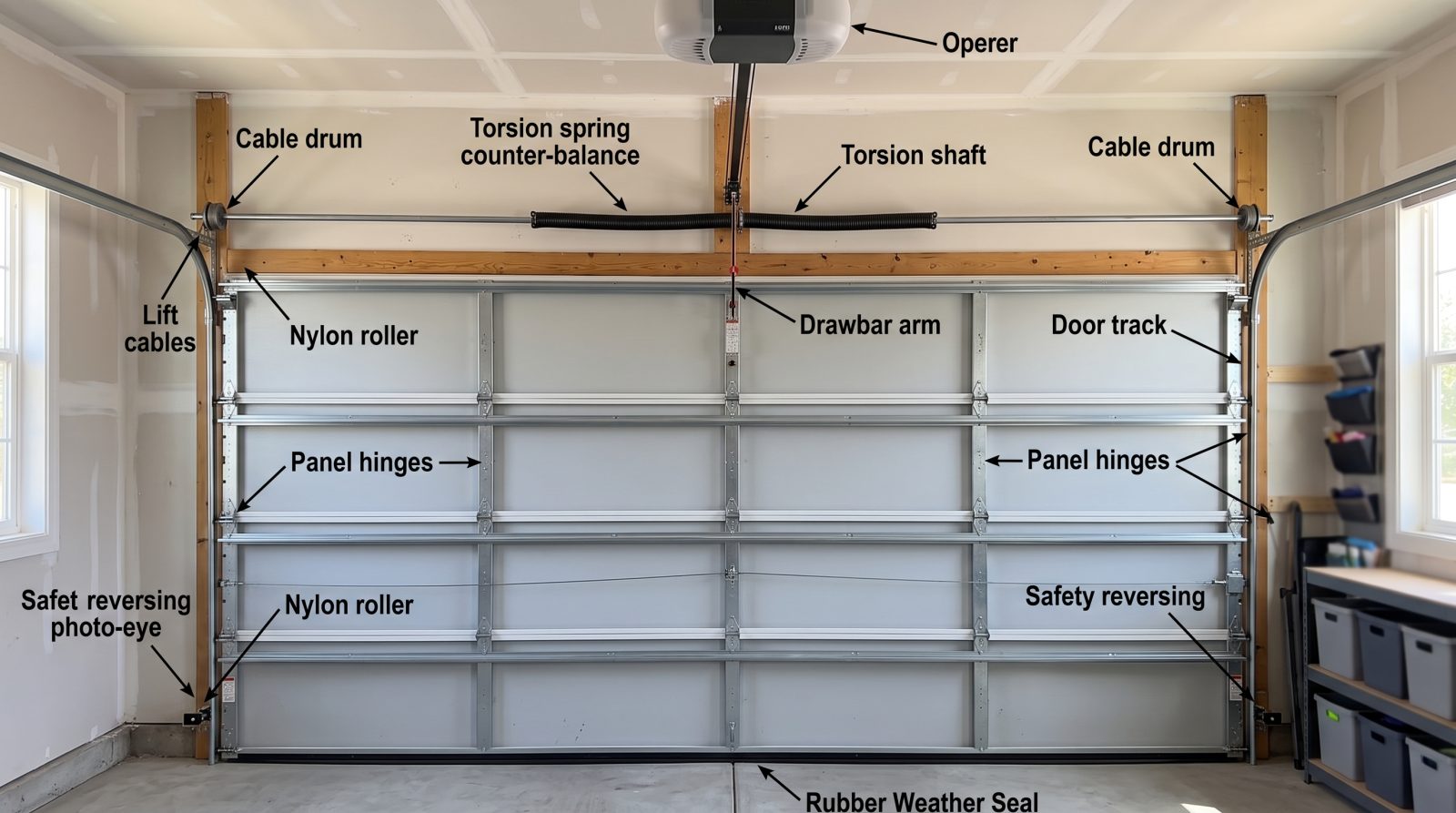
Garage door springs come in two families, and knowing which one you have helps you understand your door's behavior. Torsion springs are the more modern and common type, mounted on a metal shaft along the wall directly above the closed door. As the door lowers, cables wind the spring tight, loading it with energy; as the door rises, that stored torque unwinds and turns drums that reel the cables in, lifting the door. Torsion systems are smoother, last longer, and fail more safely than the alternative, which is why most newer San Diego tract homes in places like Carmel Valley and Chula Vista use them.
Extension springs are the older style, running parallel to the horizontal tracks on each side of the door. They stretch and contract to provide lift. They work, but a broken extension spring can become a flying projectile if it lacks a containment cable, which is one reason they are gradually being replaced. Springs are also the highest-wear part of the whole system. They are rated in cycles, where one cycle is a full open and close. A standard spring is often rated around 10,000 cycles, which sounds like a lot until you realize a busy family opening the door six to eight times a day will reach that in roughly four to seven years. San Diego's relatively mild, dry climate is gentle on springs compared to freeze-thaw regions, but coastal humidity and salt air near the coast can accelerate corrosion, which shortens spring life and is worth watching if you live within a few miles of the water.
- Torsion springs mount on a shaft above the door and are the smoother, safer, longer-lasting type
- Extension springs run along the side tracks and should always have a safety containment cable
- Springs are rated in cycles (one open + one close); ~10,000 cycles is common
- Coastal salt air and humidity can speed up spring corrosion in beach-adjacent neighborhoods
- A snapped spring is a same-day repair we handle on-site; never try to wind or unwind a torsion spring yourself
Cables, Drums, Tracks, and Rollers: The Lifting and Guiding Hardware
If the springs are the engine of the counterbalance, the cables and drums are the transmission. On a torsion system, a galvanized steel lifting cable runs from the bottom bracket on each side of the door up to a grooved drum at the end of the spring shaft. As the spring unwinds, the drums wind up the cables and lift the door evenly on both sides. Because these cables carry the door's full weight under spring tension, a frayed or rusted cable is a serious safety issue, and a cable that has come off its drum is a common cause of a door that hangs crooked or jams.
The tracks are the vertical-then-horizontal steel rails that guide the door's path, and the rollers are the small wheels at the edge of each door section that ride inside them. Quality rollers, especially nylon or sealed-bearing steel ones, keep travel quiet and smooth. Worn, dry, or bent rollers and misaligned tracks are behind a large share of the grinding, scraping, and rattling noises homeowners describe. Hinges connect the door sections and let them pivot from vertical to horizontal as the door rolls overhead. In our coastal county, salt exposure can rust budget rollers, hinges, and track fasteners faster than inland, so hardware on a Pacific Beach or Coronado door often shows wear sooner than the same hardware in El Cajon or Santee.
- Lifting cables transfer spring force to the door and must be intact and properly seated on the drums
- Drums are grooved spools that wind the cables to raise the door evenly
- Tracks guide the door; rollers are the wheels that ride inside them
- Nylon or sealed-bearing rollers run quieter and resist corrosion better than basic steel
- Grinding, scraping, or rattling usually points to worn rollers, dry hardware, or track misalignment
The Opener and Its Safety Systems
The opener is the powered unit mounted to the ceiling, and its job is to move the already-counterbalanced door along the tracks. Openers are usually classified by their drive type. Chain drives are durable and economical but noisier, which matters in homes where a bedroom sits above or beside the garage. Belt drives use a reinforced rubber belt for noticeably quieter, smoother operation, a popular upgrade in attached San Diego homes. Screw drives use a threaded steel rod and sit in between. Newer wall-mounted (jackshaft) openers clear the ceiling entirely. Most modern units add Wi-Fi so you can open, close, and check status from your phone, which is genuinely useful when you are stuck in traffic on the 5 and cannot remember if you left the door open.
Modern openers are also packed with federally required safety features, and understanding them prevents a lot of frustrating false alarms. The photo-eye sensors are two small units mounted a few inches off the ground on each side of the door; they project an invisible beam, and if anything breaks that beam while the door is closing, the door reverses. The auto-reverse mechanism also senses physical resistance: if the door contacts an object on the way down, it backs off. If your door refuses to close and the opener light blinks, the culprit is very often a misaligned or dirty photo-eye, sometimes from nothing more than a spider web, a bumped sensor, or low afternoon sun glaring into the lens. These systems are there to protect children, pets, and cars, so they should always be kept aligned and functional rather than bypassed.
- Belt drives are the quietest; chain drives are durable but louder; screw and jackshaft are alternatives
- The opener moves a balanced door; it is not the part that carries the weight
- Photo-eye sensors reverse the door if the beam is broken, protecting people and pets
- Auto-reverse also backs the door off if it hits an obstruction
- A door that won't close with a blinking light is often a misaligned, dirty, or sun-glared sensor, an easy fix
How It All Moves Together in One Cycle
Picture a single close-and-open cycle from start to finish. You press the remote and the opener engages the trolley, which pulls the door down the tracks. As the door descends, the rollers guide each section through the curve from horizontal to vertical, the cables pay out from the drums, and the springs wind tighter, storing the energy of the door's descent. Just before the door seals against the floor, the photo-eyes confirm the path is clear and the opener eases the door down rather than dropping it. The whole motion should be even, quiet, and free of jerks or hesitation.
On the way back up, the sequence reverses: the springs unwind and release their stored torque, the drums reel the cables back in, the door climbs the tracks, and the opener simply keeps pace and stops the door at the open limit. When every part is healthy, this happens in a smooth several-second arc you barely notice. When one part is off, the symptoms point to the cause. Jerky, uneven travel suggests roller or track issues. A loud bang followed by a heavy door points to a spring. A door that reverses before touching the ground points to the safety sensors or travel limits. A door that hums but doesn't move points to the opener or a disconnected trolley. Learning to read these clues means you can tell us exactly what is happening, and we can arrive prepared to fix it on the first visit anywhere across San Diego County.
- Closing: opener pulls the door down, springs wind and store energy, cables pay out
- Opening: springs release stored energy, drums wind the cables, the door rises
- Smooth, quiet, even travel is the sign of a balanced, well-maintained system
- Reading the symptom (bang, grind, hum, reverse) usually points straight to the failing part
What San Diego's Climate Means for Your Door
San Diego homeowners are spared the brutal freeze-thaw cycles that wreck doors in colder states, and our dry inland air is genuinely easy on hardware. But the county is really several microclimates, and your door's wear pattern depends on where you live. Within a few miles of the coast, in neighborhoods like Ocean Beach, Pacific Beach, La Jolla, Coronado, and Imperial Beach, salt-laden marine air is the dominant enemy. It corrodes springs, cables, rollers, hinges, and fasteners faster than inland, and it can leave rust streaks on steel door panels. Doors in these zones benefit from corrosion-resistant hardware, periodic rinsing of the exterior, and lubrication of moving metal parts a few times a year.
Inland and in the East County, in areas like El Cajon, Santee, Lakeside, and Ramona, the bigger factors are heat, fine dust, and seasonal Santa Ana winds. Heat and grit can dry out lubricant and accelerate roller and track wear, and strong winds put extra stress on the door's structure and seals. Across the whole region, the most valuable thing you can do is simple seasonal maintenance: keep the hardware clean and lubricated, watch for rust and fraying, listen for new noises, and test the balance and the auto-reverse safety features a couple of times a year. Because we are a fully mobile operation, we bring the tools and parts to your driveway, diagnose the specific way your door is wearing in your specific neighborhood, and keep it running safely without you ever leaving home.
- Coastal zones (PB, OB, La Jolla, Coronado): salt air corrodes hardware, so favor rust-resistant parts and regular lubrication
- Inland and East County (El Cajon, Santee, Lakeside): heat, dust, and Santa Ana winds drive most wear
- Mild, dry weather overall is gentle on springs compared to freeze-thaw climates
- Seasonal maintenance, clean and lubricate hardware, check balance, and test auto-reverse twice a year
- We are mobile and come to you anywhere in San Diego County to diagnose how your door is wearing locally