Why Your Garage Door Opener Stops Working
A garage door opener is a small motor doing heavy work, lifting a door that can weigh well over a hundred pounds several times a day, in a space that bakes in summer heat. Failures usually announce themselves before they go total: the door reverses halfway, the motor hums but the door doesn't move, the remote works intermittently, or the unit runs but sounds like it's grinding. Each of those symptoms points to a different culprit, which is why guessing and swapping parts blindly tends to waste money.
It also helps to separate opener problems from door problems. If the opener motor runs fine but the door is hard to lift by hand, the real issue is usually a broken spring, frayed cable, or bad rollers, not the opener. An opener is only designed to move a door that is already balanced. We always start by disconnecting the opener (using the red emergency release cord) and lifting the door manually. If it's heavy or won't stay put halfway, the door hardware needs attention first; forcing a struggling opener to compensate is exactly what burns out motors and strips gears.
- Motor hums but door won't move: often a stripped drive gear, seized motor, or a failed start capacitor
- Door reverses before closing or right after touching the floor: misaligned or blocked safety sensors, or a travel-limit setting that drifted
- Remote works sometimes or only up close: dying remote battery, antenna damage, or radio interference from a new LED bulb or nearby electronics
- Wall button works but remotes don't (or vice versa): receiver, logic-board, or programming fault rather than a mechanical failure
- Opener completely dead: tripped GFCI outlet, blown fuse on the board, surge damage to the logic board, or a failed transformer
Motor, Gear, and Drive Problems
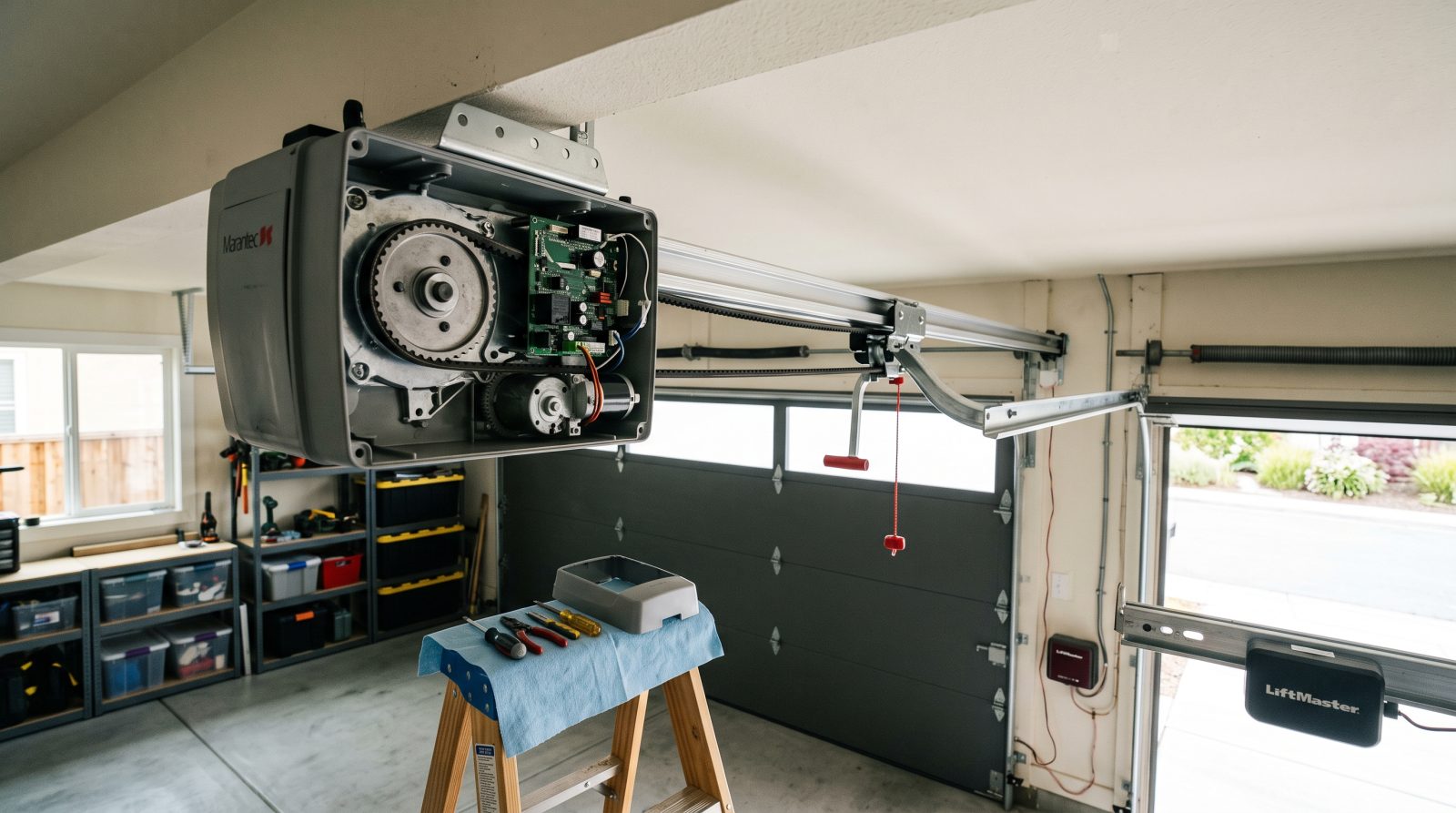
The single most common opener repair we see is the classic 'humming motor, dead door.' On chain- and belt-drive units, the most frequent cause is a stripped main drive gear, a nylon gear that meshes against the worm gear on the motor shaft. Over years of cycling, especially on a heavy or out-of-balance door, the nylon teeth shear off. The motor spins, but nothing is left to grab the chain. A drive-gear kit is an inexpensive part, and replacing it restores a perfectly good opener instead of scrapping it.
Another quiet failure is the start capacitor. Capacitors give the motor the jolt it needs to begin moving; when one weakens, you'll often hear a hum or a click without movement, or the door will start slowly and labor. On screw-drive openers, the issue is frequently a dry or dirty drive screw that needs cleaning and proper lubrication rather than parts at all. And on any drive type, a motor that smells hot, trips a breaker, or has visibly scorched windings has usually reached the end of its life, at which point we'll tell you honestly that replacement is the smarter spend.
San Diego's climate matters here. Garages near the coast, in Ocean Beach, Point Loma, or Pacific Beach, deal with salt air that corrodes hardware and contacts, while inland garages in El Cajon, Poway, and Santee can hit punishing temperatures that thicken old grease and stress motors. We carry the right lubricants and the common drive, gear, and capacitor parts on the truck so most motor-side repairs are handled in one visit.
- Stripped drive gear: very common, low-cost part, restores chain/belt openers without replacing the unit
- Weak or failed start capacitor: humming, clicking, or sluggish starts that improve with a new capacitor
- Screw-drive openers: often just need the drive screw cleaned and properly re-lubricated
- Worn trolley or broken chain/belt: door disconnects or jerks; serviceable separately from the motor
- Overheated or burnt-out motor: honestly a replacement situation, not worth chasing with parts
Logic Boards, Sensors, and Electronic Faults
When the mechanical side checks out but the opener still misbehaves, the problem is usually electronic. The logic board is the opener's brain: it reads the remotes and wall button, runs the travel limits, and controls the safety reversal. Power surges are the leading killer of logic boards. Symptoms include a completely dead unit despite good power at the outlet, flashing diagnostic LEDs, settings that won't save, or erratic behavior like the door opening on its own. Many boards are replaceable as a part, which is far cheaper than a new opener.
Safety sensors, the small 'photo eyes' mounted a few inches off the floor on each side of the door, cause more service calls than almost anything else, and many are not true failures at all. If the door refuses to close and the opener light blinks, one sensor is usually just bumped out of alignment, dirty from dust or sun glare, or has a kinked wire. We realign and clean the eyes, test the beam, and confirm the door reverses properly, which is also a federally required safety feature on residential openers, so we never bypass or disable it.
Remote and keypad issues round out the electronic category. A remote that only works up close usually needs a battery or has a damaged antenna; a keypad that's gone unresponsive may need a battery or reprogramming. We also see modern LED garage bulbs flooding the opener's receiver with radio noise and killing remote range, an easy fix once it's identified. If you've added a Wi-Fi or smart-control module, we'll make sure it's talking to the board correctly rather than fighting it.
- Logic-board failure from power surges: dead unit, won't program, flashing codes, or random operation
- Misaligned or dirty safety sensors: door won't close and the light blinks (often a quick realignment)
- We never disable safety reversal: it's a required protection on residential openers
- Remote/keypad faults: batteries, antenna damage, or reprogramming to the receiver
- Radio interference: certain LED bulbs and electronics can wreck remote range until swapped or shielded
Simple Things to Check Before You Call
Some opener 'failures' have a thirty-second fix, and we'd rather you save the service call when it's something simple. Start with power: many openers plug into a ceiling outlet that shares a GFCI circuit, and a tripped GFCI or a flipped breaker is a common reason a unit goes totally dark. Reset the outlet, check the breaker panel, and confirm the bulb in the opener lights up. If you recently had a power outage, the opener may also need its settings re-confirmed.
Next, look at the sensors. Walk to the bottom of the door and check that the two photo eyes are clean, pointed at each other, and showing a steady (not blinking) indicator light. Wipe off dust and cobwebs and gently nudge them into alignment. Also clear anything in the door's path, a trash bin, a bike, even a leaf pile can break the beam. Finally, if only the remote is failing, swap its battery before assuming the worst. If none of that brings the door back, that's when a hands-on diagnosis pays off, and overloading a failing opener with repeated button-mashing can turn a small fix into a bigger one.
Important safety note: never try to remove a garage door spring or adjust spring tension yourself. Springs store enormous force and cause serious injuries every year. Sensor cleaning, battery swaps, and resetting an outlet are homeowner-safe; anything involving springs, cables, or opening up the motor head should be left to a technician.
- Reset a tripped GFCI outlet and check the breaker, openers often share a ceiling circuit
- Clean and realign the safety sensors; look for a steady indicator light, not a blinking one
- Clear the door's track and floor of anything that could block the sensor beam
- Replace the remote battery before assuming the opener or receiver is bad
- Never DIY garage door springs or cables, those are high-tension parts that injure people
Repair vs. Replace, and What Same-Day Mobile Service Looks Like
Not every opener is worth fixing, and we'll tell you straight which way to go. A gear, capacitor, sensor, remote, or even a logic-board repair usually makes sense on a unit that's otherwise sound. Replacement starts to win when the motor is burned out, parts for an older model are discontinued, or you're facing repeated failures on a worn-out opener, especially if you'd benefit from quieter belt drive, battery backup (genuinely useful during San Diego power shutoffs), or rolling-code security and smartphone control. We base the recommendation on the actual condition of your equipment, not on selling a new unit.
As industry context, opener repairs commonly land in the lower-to-mid range of garage door service costs, while a full opener replacement with installation sits higher; the exact figure depends on the drive type, the part, the brand, and door size. These are general ranges, not a quote, your real price comes after we see the unit, and you can request a free quote before any work begins.
Because we're a mobile, we-come-to-you operation, there's no shop to drive to. We bring the diagnostic tools and the common opener parts to your home, troubleshoot the whole system (mechanical and electronic), and in most cases complete the repair in the same visit. Whether you're in downtown San Diego, North County, the South Bay, or out east, we serve the greater San Diego area and aim for same-day help. When you're ready, call or request a free quote and we'll get your opener moving again.
- Worth repairing: stripped gear, weak capacitor, sensor/alignment, remote/keypad, many logic boards
- Lean toward replacing: burned-out motor, discontinued parts, or repeat failures on a worn unit
- Upgrade perks if replacing: quieter belt drive, battery backup, rolling-code security, smart control
- Costs shown as general industry ranges, not quotes; request a free quote before any work
- Fully mobile across San Diego County with same-day service for most common opener repairs