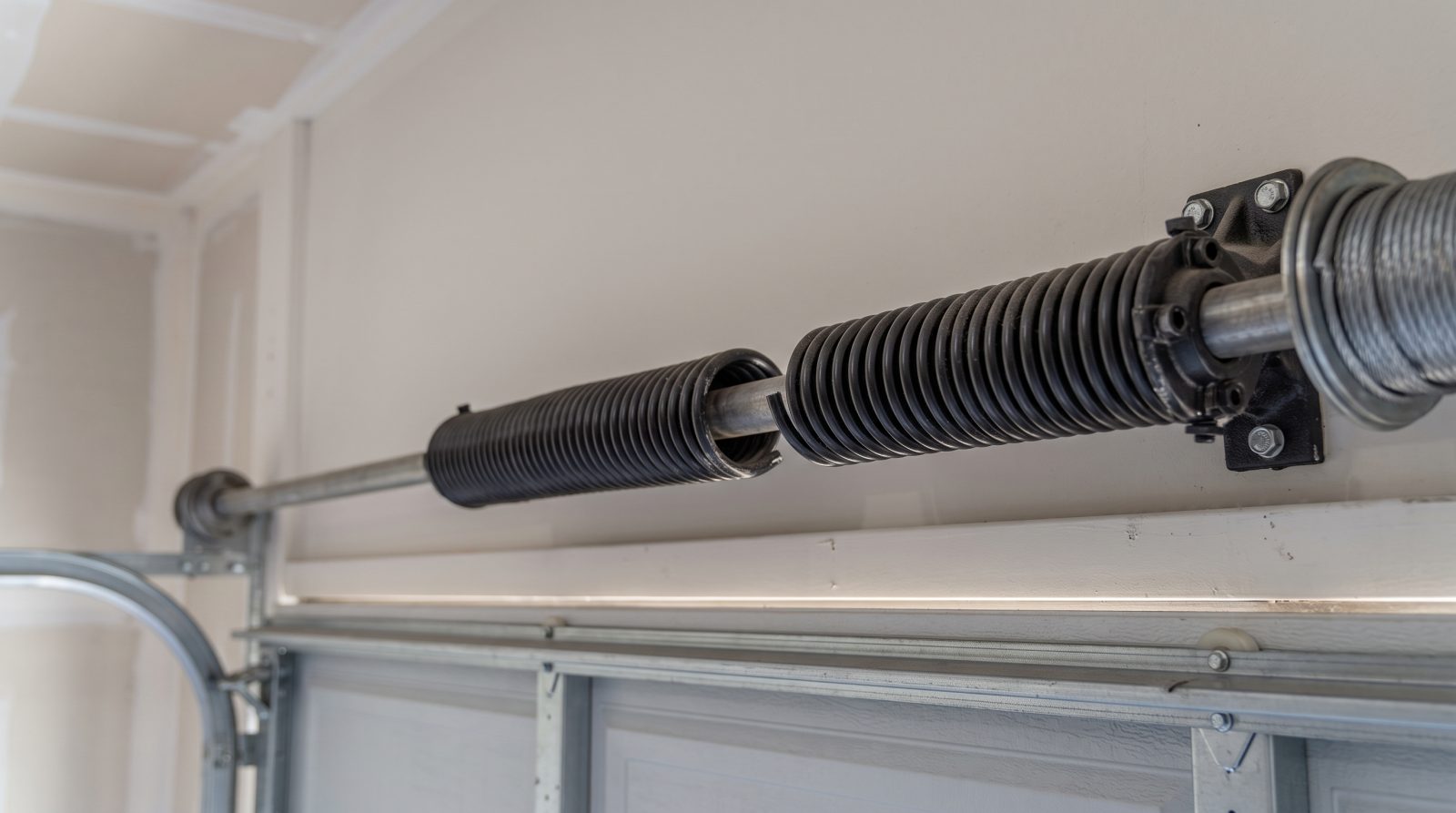
The Unmistakable Signs Your Spring Has Broken
Most spring failures announce themselves. The classic sign is a loud bang from the garage, often described as a firecracker, a gunshot, or a heavy object dropping. That sound is the steel coil snapping and releasing its stored tension all at once. If you heard it, walk out and look at the spring before doing anything else.
On a standard residential setup with a torsion spring, the spring sits on a metal shaft mounted on the wall just above the closed door. A healthy torsion spring is one continuous tight coil. A broken one will show a visible gap of one to two inches where the steel separated. On older or lighter doors with extension springs, the springs run along the horizontal tracks on each side of the ceiling, and a break there looks like a stretched, sagging, or fully snapped spring.
After a spring breaks, the symptoms are immediate and consistent. The behaviors below are the ones we see on nearly every San Diego service call where a spring is the culprit.
- A loud bang or pop came from the garage, then the door stopped working normally
- A visible gap of roughly one to two inches in a torsion spring that should be one solid coil
- The opener motor runs and the door tries to lift, then stops just a few inches off the ground
- The door feels extremely heavy, far heavier than it ever did before, if you try to lift it by hand
- The door is crooked, hanging lower on one side, or jammed at an angle in the tracks
- The opener strains, hums, or trips its safety reverse, then gives up
Subtle Warning Signs Before a Spring Fully Fails
Springs do not always go without warning. Many give you early clues days or weeks before the break, and catching them early means a planned visit instead of a door stuck shut on the morning you need to leave. Pay attention to how the door sounds and moves during normal use.
One of the most common early signs is a change in noise. A spring nearing the end of its life often develops loud creaks, squeals, or a popping sound as the coils flex unevenly. You may also notice the door moving in jerky, uneven steps rather than one smooth motion, or hesitating partway up as if it loses momentum.
Visual inspection helps too. Stand inside the garage with the door closed and look at the spring in good light. Rust, stretched or separated coils, gaps in the winding, or a spring that looks loose are all red flags. Because coastal San Diego air carries salt and moisture, especially in neighborhoods near the water like Point Loma, Ocean Beach, Pacific Beach, and Coronado, springs in those areas tend to corrode faster and deserve a closer look.
- New squealing, grinding, or popping noises during opening and closing
- The door moves in jerks or jolts instead of one smooth, steady motion
- The door briefly hangs or hesitates partway up, then continues
- Visible rust, flaking, or worn spots on the coils
- Coils that look stretched apart, loose, or unevenly spaced
- The door has felt slightly heavier or slower over recent weeks
Why Garage Door Springs Break in San Diego
Understanding why springs fail helps you know what to expect and how to extend the life of a new one. Springs are not designed to last forever. They are rated by cycles, where one cycle is the door opening once and closing once. A standard spring is often rated for around 10,000 cycles, which sounds like a lot until you count a busy family opening the door six to eight times a day. That can use up a spring in roughly seven to ten years, and high-traffic homes burn through them faster.
Metal fatigue is the leading cause. Every cycle flexes the steel a little, and over thousands of cycles tiny stress cracks form until the coil finally lets go. This is why springs so often break in cold snaps or first thing in the morning, when the metal is at its most brittle. San Diego winters are mild, but inland and higher-elevation areas like El Cajon, Santee, Ramona, and the foothills do get chilly overnight, which is when many of these breaks happen.
Corrosion is the second big factor here, and it is very much a local issue. Salt air along the coast accelerates rust, which weakens the steel and shortens spring life. Homes in beach communities should expect springs to wear faster than the same door inland. Poor maintenance speeds up both problems. Springs that are never lubricated and systems that are out of balance put extra strain on the steel and fail earlier than they should.
- Normal wear from cycle count, often a spring's life is seven to ten years of typical use
- Metal fatigue, which is why breaks cluster on cold mornings
- Salt-air corrosion, a real factor for coastal and bayfront San Diego homes
- Lack of lubrication and maintenance, which lets coils grind and rust
- An unbalanced door that overworks the spring every single cycle
- An undersized spring that was never matched to the door's true weight
What To Do, And What Not To Do, With a Broken Spring
The moment you suspect a broken spring, the most important thing is to stop using the door. Do not keep pressing the opener button. With the spring gone, the opener is trying to lift the full dead weight of the door on its own, and it was never built for that. You can burn out the motor, strip the drive gear, snap the lift cables, or bend the tracks, turning a single spring repair into a much larger one.
Do not try to force the door open by hand, and do not park your car under a partially open door that is being held up only by the opener. Without a working spring, that door can come down fast and hard. If your vehicle is trapped inside, it is safer to wait for a technician than to manually lift a heavy, unbalanced door and risk it slamming down on you or the car.
Above all, do not attempt to replace a torsion spring yourself. Torsion springs are wound under extreme tension, and the winding bars can whip violently if the job is done wrong. This is one of the few garage door repairs that genuinely sends people to the emergency room. Spring replacement calls for the right replacement spring matched to your door's weight, proper winding tools, and the experience to do it safely. That is exactly the kind of work we handle on a mobile visit.
- Stop pressing the opener button immediately to protect the motor and cables
- Do not park your car under a door held up only by the opener
- Do not try to manually lift a heavy, unbalanced door
- Never attempt a do-it-yourself torsion spring replacement
- Note whether you have one spring or two, since replacing both at once is often the smarter call
- Call for a professional diagnosis and quote before anything else
How Mobile Spring Repair Works Across San Diego
Because San Diego Garage Door is fully mobile, there is nothing for you to disassemble, load, or transport. We come to your driveway, diagnose the door on the spot, and carry the springs and tools to replace them the same day in most cases. From the coast to the inland valleys, our we-come-to-you model is built for the way the county is spread out across so many neighborhoods and canyons.
A proper spring repair is more than swapping a part. We weigh and measure the door so the new spring is correctly sized, replace springs in pairs when the door uses two so they wear evenly, and check the cables, rollers, and bearings while we are there. We then rebalance the door and test the opener's safety reverse so everything moves smoothly and the opener is no longer carrying weight it should not.
We serve homeowners throughout the region, including downtown and the central neighborhoods, the coastal communities, and the inland and East County cities. Whether you are in La Jolla, Clairemont, Mira Mesa, Tierrasanta, Rancho Bernardo, Poway, Santee, El Cajon, La Mesa, National City, Chula Vista, or the South Bay, the same mobile service comes to you. If you are not sure whether your spring is the problem, the safest move is to stop using the door and request a free quote.
- Fully mobile, we-come-to-you service with no door to transport
- Same-day spring replacement in most cases
- New springs sized to your specific door, with pairs replaced together
- A full safety check of cables, rollers, bearings, and the opener's auto-reverse
- Door rebalanced so the opener stops carrying the load
- Coverage across coastal, central, and inland East County San Diego