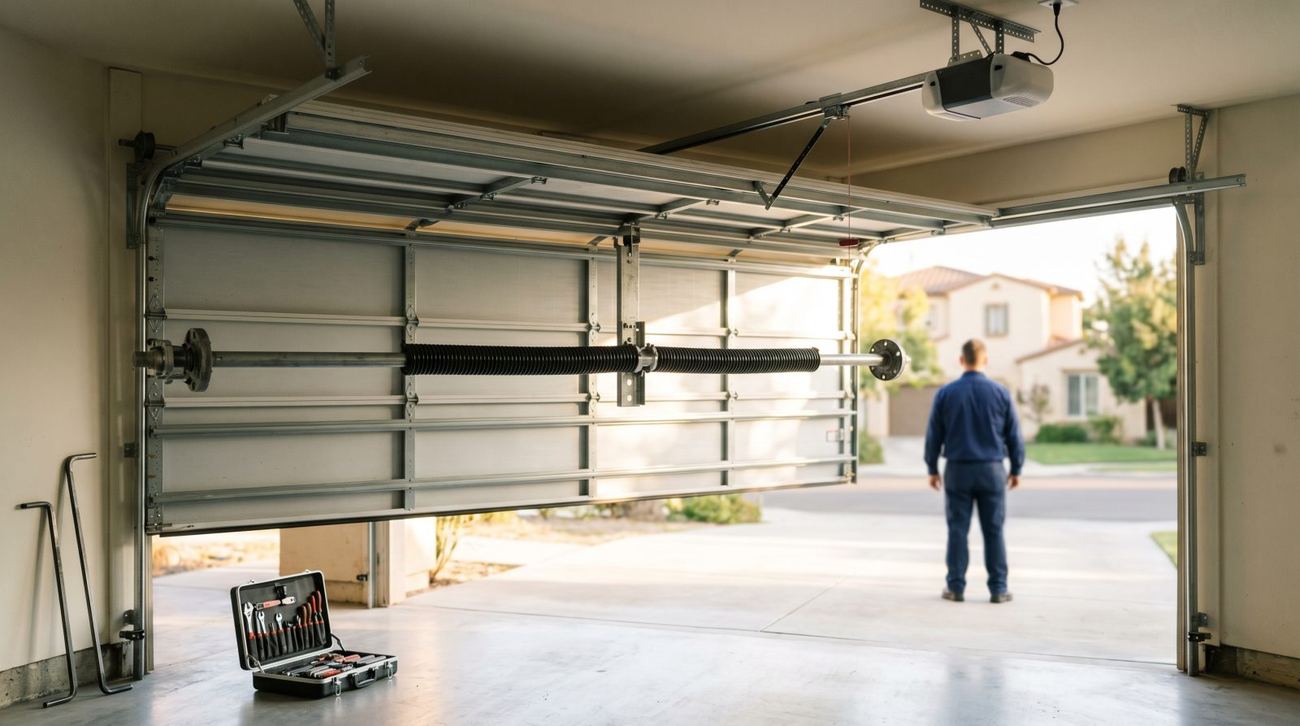
Mobile Garage Door Repair, Done at Your Home
Everything we do happens at your property. Our technicians arrive in a fully stocked vehicle carrying the springs, rollers, cables, hinges, opener parts, and hardware that cover the overwhelming majority of repairs, so most jobs are completed in a single visit. Because we're mobile, we cover a wide footprint, from coastal neighborhoods like Pacific Beach and La Jolla to inland communities such as Santee, El Cajon, and Poway, without you ever having to disconnect a door or wait days for a part to ship to a storefront.
A typical visit starts with a full safety check of the door, not just the part you noticed failing. Garage doors are balanced mechanical systems under high tension, and a single visible symptom, like a door that won't lift, often traces back to a hidden cause such as a broken spring or a frayed cable. We diagnose the whole system first, explain what we find in plain language, and give you a clear cost range before any work begins so there are no surprises.
- We come to you, anywhere across the San Diego area, with parts on the truck
- Whole-door safety inspection included with every repair visit
- Honest diagnosis and an up-front cost range before we start
- Same-day service available for most common failures
The Most Common Garage Door Problems We Fix
Most San Diego garage door calls fall into a handful of categories, and knowing which one you're dealing with helps you act safely while you wait. The single most common emergency is a broken torsion or extension spring. Springs do the heavy lifting that lets a 150-plus-pound door glide up with one finger, and when one fails you'll often hear a loud bang followed by a door that feels impossibly heavy or won't move at all. A broken spring is not a DIY job; the stored tension can cause serious injury, so the safest move is to stop using the door and call for a technician.
The second big category is doors that come off track or bind. Bent tracks, worn or seized rollers, and loose mounting brackets all pull a door out of alignment, leaving it crooked, stuck, or scraping as it moves. Forcing an off-track door usually makes the damage worse. Opener problems make up a third group, ranging from dead remotes and misaligned safety sensors to stripped drive gears and worn motors. Finally, there are the wear-and-tear issues, like frayed cables, broken hinges, cracked rollers, and worn weather seals, that don't strand you immediately but get worse and more expensive the longer they're ignored.
- Broken torsion and extension springs (door is heavy, stuck, or fell shut)
- Off-track and crooked doors from bent tracks or failed rollers
- Opener trouble: dead motors, stripped gears, bad sensors, unresponsive remotes
- Frayed or snapped lift cables and loose, worn drums
- Noisy operation, broken hinges, cracked rollers, and worn weather stripping
- Dented or damaged panels affecting how the door seals and travels
What San Diego's Climate Does to Garage Doors
San Diego is easy on a lot of home systems, but it's tougher on garage doors than people expect, and the reasons are local. Homes within a few miles of the coast, think Ocean Beach, Encinitas, Imperial Beach, and Coronado, sit in salt-laden marine air that quietly accelerates corrosion. Springs, cables, hinges, rollers, and fasteners rust from the inside out, and a door that looks fine on the surface can be one humid morning away from a snapped cable. Coastal doors generally need more frequent lubrication and hardware checks than inland ones.
Inland and hillside San Diego brings its own stresses. Many homes in areas like Scripps Ranch, Rancho Bernardo, and the canyon edges of Mission Valley deal with fine dust and debris that work into rollers and tracks, while wide afternoon temperature swings between marine layer mornings and hot, dry afternoons cause metal to expand and contract and openers to drift out of calibration. Add in the reality that the garage is the main entrance for most San Diego households, with doors cycling many times a day, and you have a recipe for parts that wear faster than the manufacturer's averages suggest. Understanding these local conditions is exactly how we prioritize what to repair now versus what to simply keep an eye on.
- Coastal salt air corrodes springs, cables, and hardware faster, so coastal doors need more upkeep
- Dust and debris inland foul rollers and tracks, causing noise and binding
- Daily temperature swings nudge openers and sensors out of alignment
- High daily use, since the garage is most homes' main door, wears parts ahead of schedule
How We Approach a Repair, Step by Step
Good garage door repair is methodical, not guesswork. When we arrive, we first make the door safe, releasing tension or securing it as needed, then run a full diagnostic across springs, cables, drums, rollers, tracks, hinges, the opener, and the safety sensors. We test door balance by hand and check that the photo-eye sensors at the base of the tracks are aligned and clean, because a door that reverses for no reason is often a simple sensor issue rather than a major failure.
Once we know the true cause, we explain your options and give a labeled cost range up front. We favor repairs that restore the whole system rather than a quick patch on one symptom; for example, replacing springs in matched pairs when one has failed, since the second is usually near the end of its life and matching them keeps the door balanced. After the fix, we re-test the full travel cycle, fine-tune the opener's force and travel limits, lubricate the moving parts, and confirm the safety reverse works. You see the door operate correctly before we leave, and we'll point out any wear worth watching so you can plan ahead instead of facing another surprise breakdown.
- Secure the door and run a full system diagnosis, not a one-part guess
- Explain the real cause and a clear cost range before any work starts
- Repair to restore balance and longevity, such as replacing springs in pairs
- Re-test the full cycle, tune the opener, lubricate, and verify the safety reverse
When to Call Now vs. When to Schedule
Some garage door problems are safety and security issues that shouldn't wait, while others can be scheduled for a convenient time. If your door won't close and your home is left open, if a spring or cable has clearly broken, if the door is hanging crooked or off its track, or if it's slamming down instead of lowering gently, treat it as urgent and stop operating the door until a technician can look at it. A door under improper tension or stuck partway is both a security risk and a physical hazard, especially around kids and pets.
Other symptoms are early warnings rather than emergencies. Grinding or rattling noises, jerky or slow movement, a door that hesitates before reversing, or visibly frayed cable strands all signal wear that's worth addressing soon, before it turns into a stranded-car morning. Whether your situation is urgent or you just want a tune-up before something fails, you can reach us to request a free quote, and we'll come to your San Diego home to take a look and make it right.
- Call right away: door won't close, broken spring or cable, off-track, or slamming shut
- Schedule soon: grinding noise, jerky travel, slow or hesitating door, fraying cables
- Don't force a stuck or off-track door; you can turn a repair into a replacement
- Request a free quote and we'll come to you, same-day when possible