Start With Your Door, Not the Opener
The single most common mistake we see is buying an opener before understanding the door it has to lift. An opener does not actually carry the full weight of the door on its own; the springs do most of that work, and the opener simply guides the last bit of force and holds the door in place. That means a door with worn or undersized springs will overwork even a powerful opener, while a properly balanced door can be moved by a surprisingly modest motor. Before you shop, it is worth knowing your door's material, size, and balance.
Run a quick balance test: with the opener disconnected (pull the red emergency release cord), lift the door by hand to about waist height and let go. A balanced door should mostly stay put. If it slams down or shoots up, the springs are out of adjustment, and no opener will fix that, it will only mask it temporarily. Material matters too. A single-layer steel door is light, an insulated double-door with windows is heavy, and a solid wood carriage-house door common on older San Diego craftsman and Spanish-revival homes can weigh several hundred pounds.
Door size drives the rest of the decision. Standard single doors (roughly 8 to 9 feet wide) are the easiest case. Wide double doors (16 feet) and tall doors, the kind you see on homes with lifted trucks, boats, or workshop conversions in places like Lakeside and Ramona, ask more of the opener and often benefit from a heavier-duty motor and a reinforced rail.
- Lightweight single steel door: most drive types and a mid-range motor will be comfortable
- Insulated double door with glass: lean toward more horsepower and a belt or jackshaft drive
- Solid wood or carriage-house door: heavier-duty motor, and confirm spring condition first
- If the door is unbalanced, fix the springs before, or at the same time as, the opener
Drive Types Explained: Belt, Chain, Screw, and Jackshaft
The 'drive' is how the opener physically moves the door, and it is the decision that most affects noise, maintenance, and price. There are four mainstream types, and each has a clear best-use case. Because so many San Diego garages sit directly beneath or beside bedrooms, especially in dense neighborhoods like North Park, Hillcrest, and the older parts of La Mesa, noise is usually the deciding factor for homeowners here.
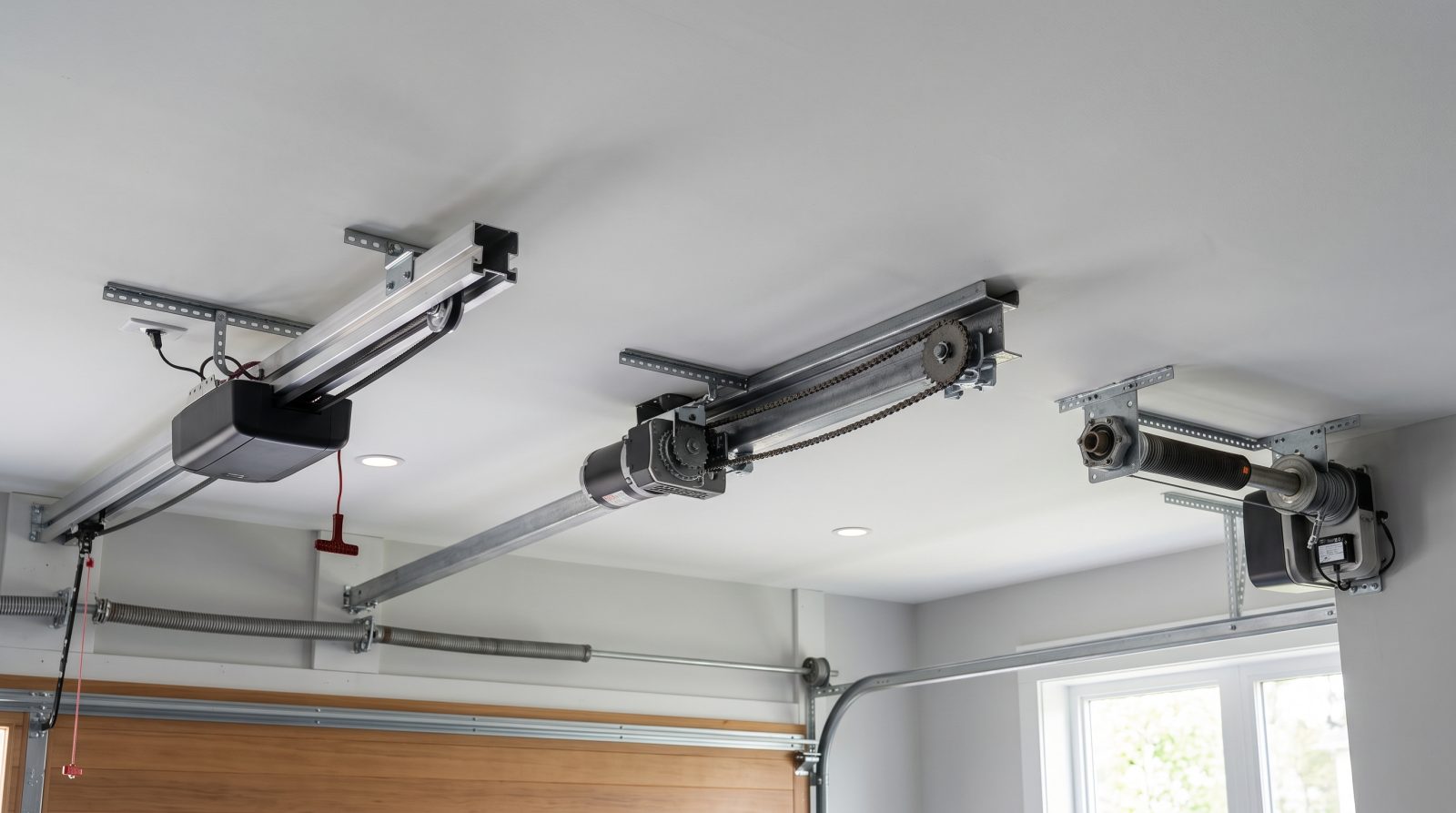
Belt-drive openers use a reinforced rubber belt and are the quietest option by a wide margin. They are the go-to recommendation for any attached garage with living space above or next to it. Chain-drive openers use a metal chain, cost less, and are extremely durable and strong, but they are noticeably louder, which is fine for a detached garage or a workshop where noise is not a concern. Screw-drive openers move a trolley along a threaded steel rod with fewer moving parts, but they historically run rougher in big temperature swings, less of an issue near the coast, more of one for inland homes in El Cajon or Poway that bake in summer.
Jackshaft (wall-mount) openers are a different design entirely. Instead of a motor on the ceiling and a long rail, the motor mounts on the wall beside the door and turns the torsion bar directly. They free up overhead space, which is ideal for garages with high or vaulted ceilings, low headroom, ceiling-mounted storage racks, or anyone planning a car lift. They tend to be the most expensive option but are quiet, clean-looking, and excellent for heavier doors.
- Belt drive: quietest; best for attached garages under or beside bedrooms
- Chain drive: strongest value and very durable; loud, so best for detached garages and shops
- Screw drive: fewer parts; can run rough in extreme heat, more relevant for inland San Diego
- Jackshaft / wall-mount: frees ceiling space, great for high ceilings, storage racks, and heavy doors
How Much Horsepower Do You Actually Need?
Horsepower (HP) is the spec people fixate on, but more is not automatically better, it just costs more and can be overkill. What you are really paying for is enough motor to move your door smoothly for years without straining. Manufacturers rate openers in horsepower or, increasingly, in 'newtons' of force or HP-equivalent (HPc) for DC motors, so the labels can be confusing. The practical translation is straightforward once you know your door.
For a standard single door that is properly balanced, an entry-level motor is genuinely adequate, though a mid-tier unit gives you smoother starts and stops and a longer service life. For a typical insulated double door, the common sweet spot is a step up in power, enough to lift the extra weight without lugging. For oversized, very tall, or solid-wood doors, the heavy-duty tier earns its keep and tends to last longer under load. DC motors, now standard on better openers, are quieter, start and stop softly (gentler on the door), and usually include a battery backup option.
A note on cost, because it is the first question everyone asks. As an industry range, basic opener units typically run on the lower end, mid-tier belt-drive smart openers sit in the middle, and premium jackshaft or heavy-duty models are at the top, with professional installation added on top of the hardware. Those are general ranges, not a quote; the right number for your home depends on your door, your wiring, and the accessories you choose. We are happy to give you a straightforward estimate when we see the door.
- Standard single door: entry to mid-tier motor is usually plenty for a balanced door
- Insulated double door: step up in power for smooth, unstrained lifts
- Oversized, tall, or solid-wood doors: heavy-duty tier for longevity under load
- Favor a DC motor: quieter, soft start/stop, and battery-backup compatible
- Costs above are labeled industry ranges, not quotes, real numbers depend on your specific door and setup
Features Worth Paying For (and Ones to Skip)
Modern openers come loaded with features, and a few of them genuinely change daily life while others are nice-to-haves. The one we recommend without hesitation for San Diego is battery backup. California law (SB 969) has required battery backup on residential garage door openers sold and installed in the state for several years now, specifically so doors can still open during a power outage, a real concern during fire-season public-safety power shutoffs and grid strain. If you are replacing an older unit, this is one area where a current opener is simply safer.
Smart connectivity (Wi-Fi with a phone app) is the feature most homeowners end up loving. It lets you check whether the door is closed from anywhere, get an alert if it was left open, and grant access to family or a delivery person without handing out remotes. If you have ever driven halfway to work wondering if the garage is open, this pays for itself in peace of mind. Pair it with a smart keypad and you can drop the spare key under the mat for good.
Other features range from genuinely useful to optional. Built-in LED lighting and motion-activated lights are a real upgrade in a dark garage. A second wireless keypad is cheap and convenient. Auto-close timers add a safety net. Where we tell people to relax is on ultra-premium add-ons they will not use, the smarter spend is almost always on the right drive type, a quiet DC motor, and good safety sensors rather than gadgets.
- Battery backup: required by California law (SB 969) and genuinely valuable during outages, do not skip it
- Wi-Fi / smart app: check and control the door remotely, get left-open alerts, the most-loved feature
- Smart keypad: keyless entry for family, guests, and deliveries, no spare key needed
- Bright LED or motion lighting: a real quality-of-life upgrade in a dim garage
- Skip: gimmick add-ons you will not use, spend on drive type, motor quality, and safety sensors instead
San Diego Realities: Coast, Heat, and Older Homes
Where your home sits in the county genuinely changes the recommendation. Along the coast, from Point Loma and Ocean Beach to Encinitas and Carlsbad, salt-laden marine air accelerates corrosion on metal parts. Chains, exposed steel rails, springs, and fasteners can rust faster than they would inland. For coastal homes we lean toward belt or jackshaft drives (less exposed metal moving back and forth) and we pay extra attention to corrosion-resistant hardware and regular maintenance to keep things moving smoothly.
Inland and East County tell a different story. Summers in El Cajon, Santee, Lakeside, and Ramona get hot, and an un-insulated garage can climb well past comfortable. Heat is one reason we steer inland homeowners away from older screw-drive designs and toward DC belt drives or jackshafts that handle temperature swings better. If your garage doubles as a gym, office, or workshop, a quieter, cooler-running opener and an insulated door together make a noticeable difference.
Then there is San Diego's housing stock. Neighborhoods like Kensington, Mission Hills, South Park, and parts of La Jolla have charming older homes, sometimes with detached garages, low headroom, original wood doors, or non-standard openings. These are exactly the cases where a wall-mount jackshaft or a carefully chosen heavier-duty opener solves problems an off-the-shelf big-box unit cannot. Because we are mobile and come to you, we can look at your specific garage, measure the headroom and door, and recommend an opener that actually fits the home rather than a one-size-fits-all box.
- Coastal (Point Loma, OB, Encinitas, Carlsbad): favor belt/jackshaft and corrosion-resistant hardware against salt air
- Inland / East County (El Cajon, Santee, Lakeside, Ramona): choose DC belt or jackshaft drives that tolerate heat better
- Older neighborhoods (Kensington, Mission Hills, South Park, La Jolla): low headroom and wood doors often call for a wall-mount jackshaft or heavier-duty unit
- We come to you to measure headroom, door weight, and wiring before recommending a specific opener
Installation, Safety, and Knowing When to Call a Pro
Every opener installed in California must have working photo-eye safety sensors, the two small units near the floor on each side of the door that reverse it if something (a pet, a child, a bike) is in the path. They are not optional and they are not just a convenience; they are the core safety system. Any new install should include them properly aligned and tested, and any opener that does not reverse when the beam is broken needs immediate attention.
A few things make installation more involved than a typical weekend project: anchoring the motor and rail securely to the ceiling structure, wiring in a hardwired wall control and the safety sensors, setting the open and close force limits correctly so the door is both safe and reliable, and connecting battery backup and smart features. Setting force limits wrong is a common DIY error, too tight and the door reverses for no reason, too loose and it can fail to stop on an obstruction. On heavier doors, the install also has to account for the door's weight and spring condition, which is where a balance check comes back into play.
If your existing opener is more than 15 to 20 years old, lacks battery backup, runs loud enough to wake the house, or has sensors that no longer work, it is usually a better value to replace it than to keep patching it, and a new DC belt or jackshaft unit will be dramatically quieter and safer. When you are ready, San Diego Garage Door will come to your home, confirm the door is balanced and the springs are healthy, recommend the right opener for your situation, and handle a clean, code-correct, same-day install in most cases. Call or request a free quote and we will help you choose with no guesswork.
- Photo-eye safety sensors are required and must be tested, the door must reverse when the beam is broken
- Correctly set open/close force limits are critical and a frequent DIY mistake
- Battery backup, smart wiring, and secure mounting make professional install worthwhile
- Replace rather than repair if the opener is 15+ years old, lacks battery backup, or is loud and unsafe
- We are mobile: we come to you, verify door balance, recommend the right unit, and install, often same-day