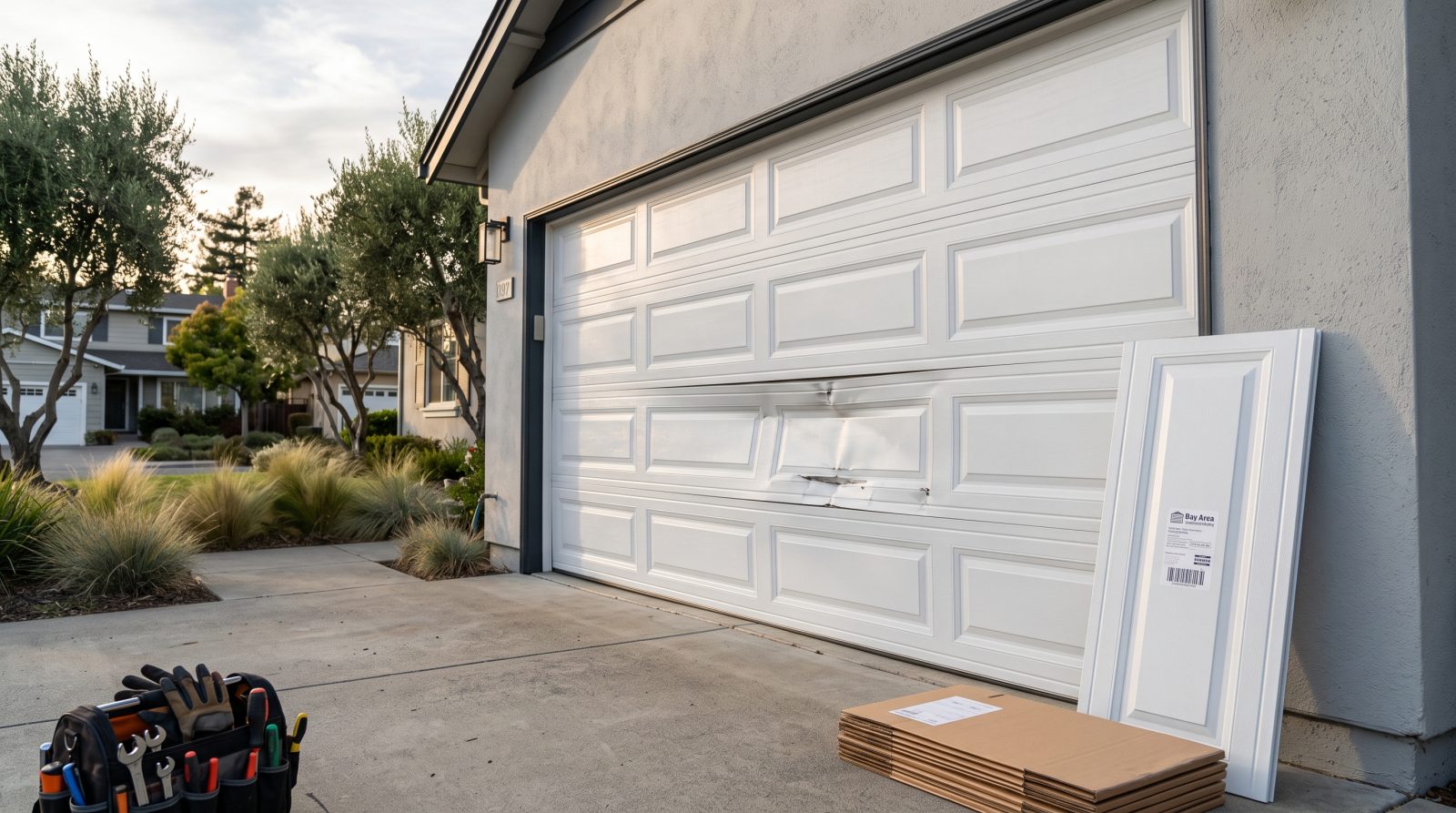
When a Single Panel Replacement Is the Right Call
Most sectional garage doors are built from three to five horizontal panels stacked on top of each other and connected by hinges. Because they are modular, a door that is damaged in one spot can frequently be fixed by swapping just the affected section rather than replacing everything. That is good news for your budget and your schedule. The key question we answer on-site is whether the rest of the door, the track, and the structure are sound enough that a panel swap restores it to like-new performance.
Panel replacement is usually the smart move when the damage is isolated, the door is relatively modern, and the model is still being manufactured or has a close current-production match. A car or trash can that backed into the bottom section, a basketball or storm-driven object that cracked a single panel, or one section that has rusted faster than the others are all classic single-panel situations. If the door is otherwise straight, the rollers and springs are healthy, and the panels are not delaminating, a targeted replacement is often the most cost-effective repair available.
- Damage is limited to one or two sections, not spread across the whole door
- The door's brand, model, and panel style are still available or have a current match
- The rest of the door is straight, with no widespread rust, rot, or delamination
- Springs, rollers, and tracks are in good shape and not contributing to the damage
- You like the existing door's look and color and want to keep it
Matching Panels So the Repair Blends In
The hardest part of a panel replacement is rarely the labor; it is the match. Garage door manufacturers change panel designs, window inserts, embossing patterns, and color formulas over the years, and a section that is even slightly off in profile or shade can make a repair look more obvious than the dent it replaced. Our job is to get as close as possible to a seamless result, and we are upfront with you about what a realistic match looks like before we order anything.
On-site we identify the door's manufacturer and model wherever a label or stamp exists, measure the panel height and width, and document the design details: long-panel versus short-panel (raised) styling, flush versus grooved faces, any decorative overlays, and the exact window layout if your door has glass. We also factor in San Diego's strong, consistent sun, which fades factory paint over time. A brand-new panel can read brighter than weathered neighbors, so we will talk through options such as choosing a finish that ages in or, in some cases, repainting a section to harmonize with the rest of the door.
When an exact factory match is no longer made, we will tell you honestly rather than installing something that clashes. Depending on the door, the alternatives may include sourcing a compatible current-production panel, replacing two sections so they visually balance, or recommending a full door if a believable match simply is not achievable. You get the trade-offs in clear terms so you can decide what is worth it for your home.
- We identify make, model, and panel style from labels, stamps, and measurements
- We match profile (raised vs. flush), embossing, and window inserts, not just color
- We account for sun-faded existing panels versus a fresh factory finish
- If an exact match is discontinued, we explain compatible options before ordering
- Glass, hardware, and weather seals are matched and reinstalled to suit your door
How Our Mobile Panel Replacement Works
Because we are a mobile service, the entire process happens in your driveway. There is no storefront to visit and no need to haul a heavy, awkward door section anywhere. We come to you across the San Diego area, assess the door in person, and handle the work on-site once you approve the plan and the matched panel is in hand.
Safety comes first on every visit. Garage door springs store significant energy, and a single panel cannot be removed safely until the door is properly secured and tension is managed. Our technician disconnects the opener, secures the door, and carefully detaches the hinges and hardware connecting the damaged section. The old panel comes out, the replacement goes in, and we transfer or replace hinges, rollers, brackets, and weather seals as needed so the new section integrates cleanly with the rest of the door.
After installation we re-balance the door, reconnect the opener, and run it through several full cycles to confirm it travels smoothly, seals at the floor, and reverses correctly on the safety sensors. We also walk you through the finished result, point out anything to watch, and clean up so the only thing left behind is a door that looks and works right.
- On-site assessment and an honest repair-vs-replace recommendation
- Door secured and spring tension managed before any panel is removed
- Damaged section swapped, with hinges, rollers, and seals serviced as needed
- Door re-balanced, opener reconnected, and safety reversal tested
- Multiple full open/close cycles to verify smooth, quiet operation
Local San Diego Realities That Affect Your Panels
San Diego's climate is gentle on a lot of things, but it has a real effect on garage doors. Near the coast, in neighborhoods like Ocean Beach, Pacific Beach, La Jolla, Point Loma, and Coronado, salt-laden marine air accelerates corrosion on steel panels, hinges, and hardware. It is common to see one lower section rust or bubble at the seams while the upper sections still look fine, which is exactly the kind of isolated damage a single-panel replacement is built for. When we replace a coastal panel, we pay extra attention to the condition of the surrounding hardware so the new section is not bolted to parts that are about to fail next.
Inland and farther east toward areas like El Cajon, Santee, and Poway, the bigger factor is intense, persistent sun and heat. UV exposure fades paint and can stress older panel materials over the years, so the match conversation matters even more there. South Bay communities such as Chula Vista, National City, and Imperial Beach see a blend of both: coastal influence plus strong sun. Wherever you are in the county, we tailor the recommendation to what the local environment is actually doing to your door rather than applying a one-size-fits-all fix.
Day-to-day life adds the rest. Tight driveways and alleys in older central neighborhoods, busy two-car households, and the simple reality of backing out in a hurry all lead to the kinds of dings and dents that bring homeowners to us. Whatever caused the damage, our mobile setup means we meet you where the door is.
- Coastal salt air can corrode lower steel panels and hardware first
- Inland sun and heat fade paint, making careful color matching important
- We inspect surrounding hardware so a new panel isn't paired with failing parts
- Mobile service reaches tight driveways and alleys across the county
- Recommendations are tailored to your specific neighborhood's conditions
What Panel Replacement Typically Costs
Every door is different, so the most accurate number comes from an on-site look. That said, it helps to understand what drives the price. The two biggest factors are the panel itself, the brand, material (steel vs. composite vs. insulated), size, and whether it includes windows, and how available a match is. A common, currently produced steel section for a standard door is usually the most affordable scenario. A discontinued design, an insulated or carriage-style panel, or one with decorative glass costs more to source.
As a general, industry-wide frame of reference and not a quote, single-panel replacements often land in a lower range than a full door replacement when a good match exists, while insulated, custom, or hard-to-match sections trend higher. Labor, any hinges, rollers, brackets, or weather seals that need replacing, and the number of sections involved all factor in. When a believable match is not available and we would be installing one new panel next to several weathered ones, a full door sometimes becomes the better value, and we will say so plainly.
When our technician arrives, you get a clear, itemized explanation of the recommended work and a free quote before anything is ordered or removed. No surprises, no pressure, just straight information so you can make the right call for your home and budget.
- Panel type drives cost: standard steel is lower; insulated, custom, or glass run higher
- Match availability matters; discontinued designs cost more to source
- Hinges, rollers, brackets, and seals may add to the total if worn
- All figures here are industry ranges for context, not quotes
- You receive a clear, itemized free quote on-site before work begins