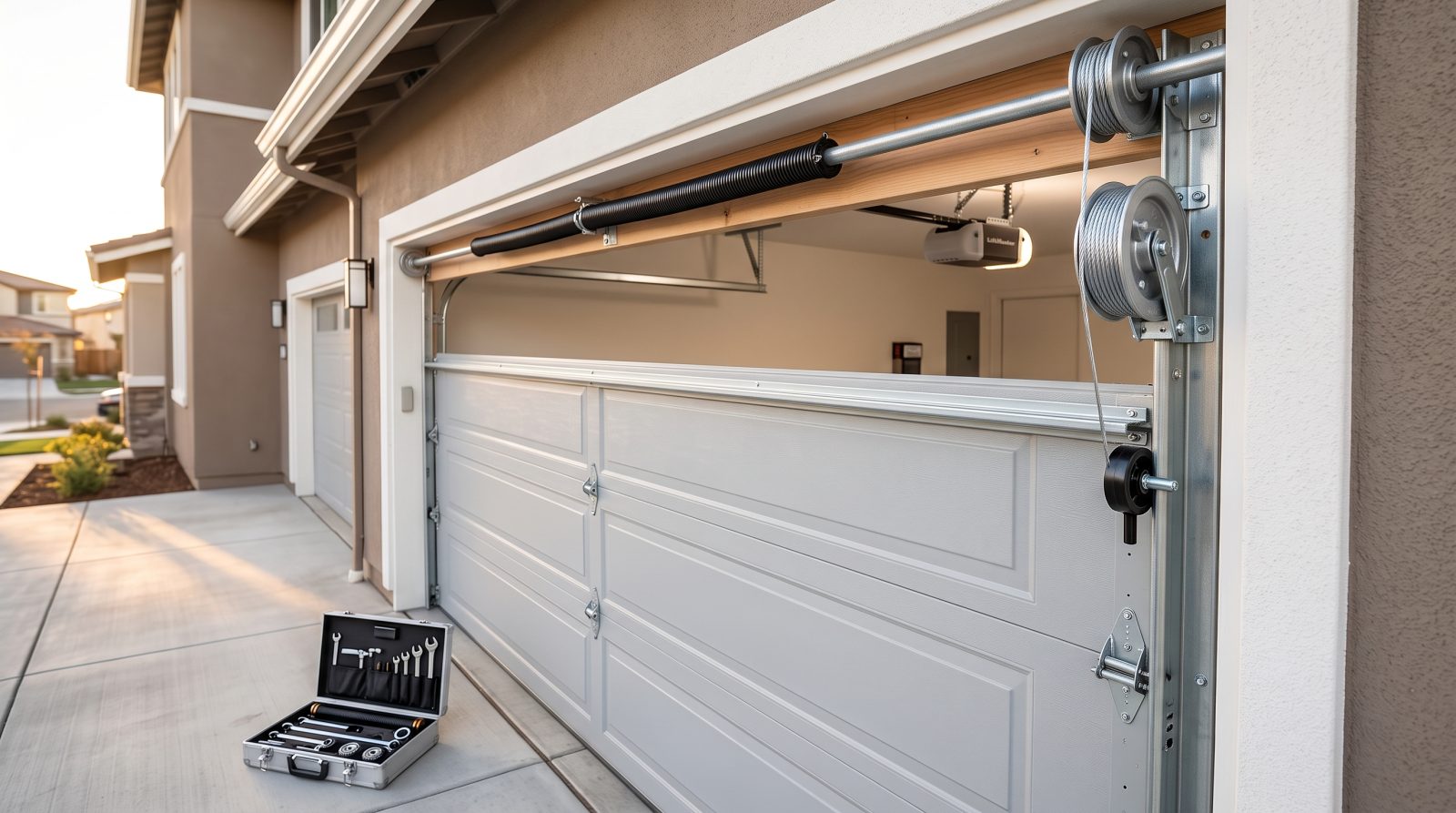
How Garage Door Repair Pricing Actually Works
Most garage door repairs are priced from three things: the cost of the replacement part, the labor and skill required to install it safely, and the type of door you have. A single-car, lightweight steel door is faster and cheaper to work on than a heavy, two-car insulated door or a solid-wood custom door, which are common on the larger homes in places like Scripps Ranch, Carmel Valley, and Rancho Bernardo. The same repair can land at different points in a range simply because the door weighs more and needs heavier-duty hardware.
Service-call or diagnostic fees are normal in this trade. A technician has to drive to you, inspect the system, and tell you exactly what's wrong, and that time has value. Many companies, including ours, apply that diagnostic fee toward the repair if you move forward the same visit. Always ask up front whether the diagnostic is credited, because that single question can change the real out-the-door cost more than the headline price.
San Diego's coastal environment quietly drives cost too. Homes near the water in Point Loma, Ocean Beach, Pacific Beach, and La Jolla deal with salt air that corrodes springs, cables, hinges, and rollers faster than inland homes in El Cajon or Poway. Rusted, seized hardware takes longer to remove and is more likely to need full replacement rather than a quick adjustment, which is a real and legitimate reason a quote may come in higher than a brand-new system would.
- Part cost: the spring, opener, cable, roller, or panel itself
- Labor and skill: spring and cable work is high-tension and safety-critical
- Door type and weight: single vs. double, steel vs. wood, insulated vs. not
- Diagnostic/service fee: ask whether it's credited toward the repair
- Coastal corrosion: salt air near the coast ages hardware faster
Typical Cost Ranges by Repair Type
Below are the repairs San Diego homeowners ask about most, with typical industry price ranges that include parts and labor. Treat these as planning numbers. Your exact price is confirmed on-site once we see the door, because the difference between a single torsion spring and a heavy double-door system, or between a simple sensor realignment and a full opener replacement, is significant.
Spring repairs are the most common call we get, and they're also the most safety-critical. Torsion and extension springs are under extreme tension and store enough force to cause serious injury, which is why this is firmly a professional job. If one spring on a two-spring system has snapped, it's almost always smart to replace both, since they wear at the same rate and a fresh spring paired with a worn one fails again quickly.
Opener issues range from a cheap fix to a full unit swap. A door that won't close and reverses immediately is often just misaligned or dirty safety sensors, which is one of the least expensive things we touch. A burned-out motor, stripped gear, or a unit old enough that parts are scarce usually points toward replacement, where newer models add quieter belt drives, battery backup, and smartphone control.
- Torsion or extension spring replacement: roughly $200-$500+ (higher for heavy double doors or dual-spring jobs)
- Garage door opener repair (gears, circuit board, capacitor): roughly $125-$300
- Garage door opener replacement (unit + install): roughly $400-$700+ depending on drive type and features
- Cable replacement (one or both): roughly $130-$300
- Roller replacement (full set): roughly $100-$250
- Off-track door realignment: roughly $130-$300+ depending on damage
- Hinge, bracket, or hardware replacement: roughly $100-$250
- Safety sensor realignment or replacement: roughly $85-$200
- Single panel/section replacement: roughly $250-$800+ depending on door brand and match availability
- Weather seal / bottom seal replacement: roughly $75-$200
- General tune-up (lubricate, balance, adjust, tighten): roughly $80-$150
Repair vs. Replace: When Fixing Stops Making Sense
A good repair company should tell you when a repair isn't worth it, even though a replacement is the bigger ticket. As a general rule, if the cost to repair approaches a meaningful fraction of a new door and the door is already old or failing in multiple places, replacement is the smarter long-term spend. A door that has had three separate repairs in a year is sending you a message.
Watch for clusters of problems. A door with a snapped spring is a simple fix, but a door with a snapped spring, frayed cables, cracked rollers, and a sagging bottom panel is a system at the end of its life. Patching one piece at a time on a worn-out door means paying for repeated service calls that add up to more than a single replacement would have cost.
Physical damage is its own category. A door that's been backed into or warped by impact, with bent tracks and crushed sections, often can't be returned to safe, smooth operation no matter how much labor goes in. In coastal San Diego, severe rust through the bottom sections of a door is a similar tipping point. We'll always quote the honest repair first and only recommend replacement when the numbers and safety genuinely favor it.
- Repeated failures: multiple repairs on the same door within a year
- Multiple worn components failing at once (springs + cables + rollers + panels)
- Major impact damage: bent tracks, crushed or warped sections
- Severe coastal rust through the bottom panels or hardware
- An opener old enough that replacement parts are hard to source
What a Mobile, We-Come-to-You Repair Means for Your Cost
Because we're a mobile San Diego garage door company, there's no showroom or storefront overhead baked into your price, and there's no hauling your door anywhere. The truck is the shop. We arrive stocked with the springs, cables, rollers, opener parts, and hardware that fit the vast majority of residential doors across the county, so most repairs are diagnosed and completed in a single same-day visit rather than a diagnosis today and a return trip next week.
Single-visit repairs save you more than time. Every return trip is another service window to wait through and, with some companies, another fee. When the right parts are already on the truck, you avoid the second-visit markup entirely. If your door uses an unusual or discontinued panel, color, or proprietary part, we'll be upfront that it may need to be ordered, and we'll give you the timeline before you commit to anything.
Coming to you also means the quote reflects your actual door. A phone estimate is a guess; a tech standing in your driveway in Chula Vista, Santee, Encinitas, or Mira Mesa can weigh the door, test the balance, and see the real condition of the hardware. That's why our on-site number is firm and the ranges above are only a starting point for your planning.
- No storefront overhead priced into the job
- Truck stocked for most common residential repairs = same-day fixes
- Fewer return trips means fewer repeat service fees
- On-site diagnosis gives you a firm price, not a phone guess
- Honest timelines when a special-order part is genuinely required
Smart Ways to Keep San Diego Garage Door Costs Down
The cheapest repair is the one you prevent. A garage door is the largest moving object in most homes and runs thousands of cycles a year, and small, inexpensive maintenance dramatically extends the life of expensive parts like springs and openers. A quick annual tune-up to lubricate moving parts, check the balance, and tighten loosened hardware costs a fraction of an emergency spring replacement and often catches problems before they strand your car in the garage.
Address small symptoms early. A door that's grinding, jerking, sagging on one side, or suddenly louder is telling you something is wearing or going out of adjustment. Worn rollers left alone chew up tracks; a door that's slightly out of balance forces the opener to overwork and shortens its life. Calling on a $90 symptom is far cheaper than calling on the $400 failure it becomes.
Near the coast, rinse and inspect more often. Salt air is relentless on metal hardware, so homeowners in La Jolla, Point Loma, and the beach communities benefit from lubricating and inspecting springs, hinges, and rollers more frequently than the inland average. When you do replace parts in a coastal zone, ask about corrosion-resistant hardware so the upgrade lasts longer before the salt air gets to it.
- Get an annual tune-up: lubricate, balance, and tighten hardware
- Act on early symptoms (noise, jerking, sagging) before they escalate
- Replace both springs together when one breaks to avoid a fast repeat
- Coastal homes: inspect and lubricate metal hardware more often
- Ask about corrosion-resistant parts if you live near the water