Why insulation matters more in San Diego than people assume
San Diego has a reputation for perfect weather, and that reputation quietly convinces homeowners they don't need an insulated garage door. The reality is more nuanced. Our climate is not one climate, it's a stack of microclimates that change within a few miles. A garage in Pacific Beach lives in cool, damp marine air much of the year, while a garage in Santee, Poway, El Cajon, or Ramona can bake well past 95 degrees on a summer afternoon and then drop sharply overnight. A single-skin, uninsulated steel door is essentially a giant radiator: it soaks up sun all day and dumps that heat straight into the garage, then into any attached living space.
The other half of the story is how San Diegans actually use their garages. With home values and ADU interest where they are, the garage is rarely just for the car anymore. It's a home gym, a remote office, a band room, a woodshop, a teenager's hangout, or a converted studio. The moment you spend real time in there, the door's insulation stops being a technical spec and becomes the difference between comfortable and miserable. An insulated door also buffers an attached garage that shares a wall with a bedroom or living room, which can take real load off your AC and even out the temperature in the rooms next door.
- Inland communities (El Cajon, Santee, Lakeside, Poway, Ramona) see real summer heat that an uninsulated door pours into the garage
- Coastal areas (OB, Point Loma, PB, La Jolla, Coronado) deal with constant damp marine air where a sealed, insulated door helps control moisture and condensation
- Attached garages share walls and ceilings with living space, so the door affects the comfort and energy use of the rooms next to it
- Garage gyms, offices, and ADUs only work well when the temperature inside stays reasonable
How R-value really works (and how to avoid being misled)
R-value measures how well a material resists heat flow. The higher the number, the slower heat moves through the door. That part is simple. Where it gets confusing is that the garage door industry publishes the number two different ways, and they are not comparable. Some manufacturers quote the R-value of the insulation core in the center of a panel, which is the best-case number. Others quote a calculated whole-door value that accounts for the steel skins, the seams, and the frame, which is lower but far more honest about real-world performance. When you compare two doors, make sure you're comparing the same kind of number, because a flattering core figure can look much better than a door that actually performs worse.
For most San Diego homes, you don't need the highest R-value on the market. Because our temperature swings are milder than the desert or the Midwest, a mid-range insulated door usually delivers most of the comfort benefit without paying for extreme thickness you'll never notice. The bigger wins often come from the door's construction and how well it seals at the perimeter and between sections. A modest R-value door with tight weatherseals and a snug fit will beat a higher-rated door with gaps every time. We'll give you a straight read on what level of insulation genuinely changes things for your garage versus where the spec sheet is just marketing.
- Core (or center-of-panel) R-value is the marketing best case; whole-door R-value reflects real performance
- Higher R-value is not automatically worth it in San Diego's mild swings; balance it against cost
- Sealing and fit matter as much as the rated number; gaps undo good insulation
- Two-layer vs three-layer construction also affects strength, quietness, and durability, not just R-value
- Ask which kind of R-value is quoted before comparing any two doors on price
Polyurethane vs polystyrene: which insulation fits your home
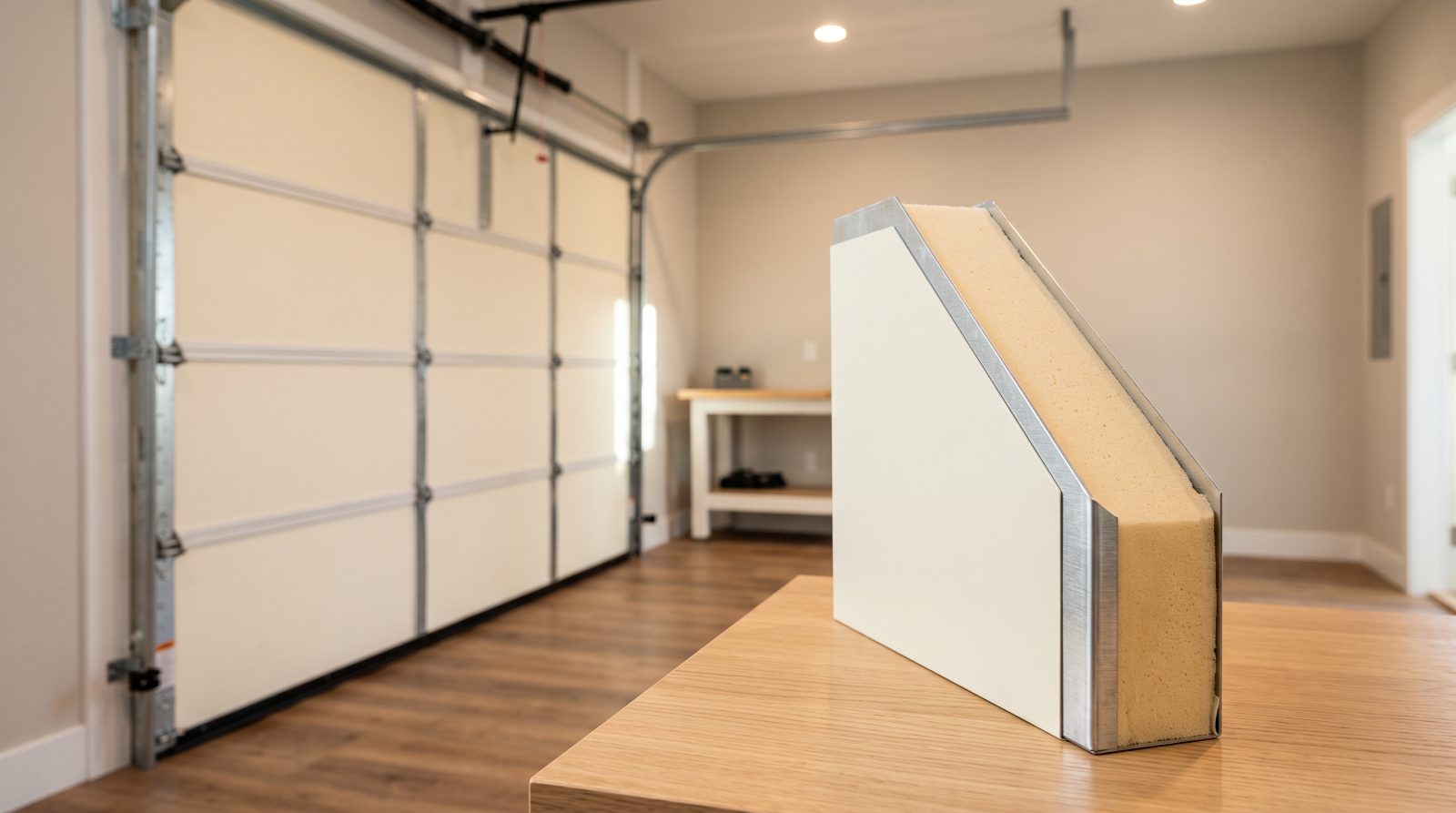
Insulated garage doors generally use one of two core materials, and the difference is meaningful. Polystyrene is rigid foam board cut to fit inside the door sections. It's the more affordable option, provides a solid improvement over a hollow door, and is a sensible choice for a detached garage or a budget-conscious project where you mainly want to take the edge off the heat and add some quiet. Polyurethane is foam that's injected and expands to bond tightly to both steel skins. It fills the section completely, which yields a higher R-value per inch, a stiffer and stronger door, and better sound dampening. For an attached garage, a converted living space, or a coastal home where you want the door as solid and sealed as possible, polyurethane is usually the better long-term value.
Construction layers go hand in hand with the core. A two-layer door has a steel skin on the outside with insulation behind it. A three-layer door sandwiches the insulation between an outer and an inner steel skin, which protects the foam, resists dents from the inside, and gives the door a clean finished look from within the garage. For a garage you spend time in, the inner skin of a three-layer door also wipes clean and stands up to bikes, tools, and daily life far better than exposed foam.
- Polystyrene: lower cost, good improvement over a hollow door, great for detached or budget projects
- Polyurethane: higher R-value per inch, stronger, quieter, and better sealed; ideal for attached or coastal homes
- Two-layer: steel skin plus insulation, no inner skin
- Three-layer: insulation sandwiched between two steel skins for strength, a finished interior, and the best sound control
- If the garage is a room you use daily, the finished inner skin is worth it
Coastal corrosion: the San Diego factor most guides ignore
If you live anywhere near the water, salt air is the quiet enemy of every garage door, and it's a factor most national buying guides never mention. In neighborhoods like Ocean Beach, Point Loma, Pacific Beach, La Jolla, Imperial Beach, and Coronado, airborne salt and persistent marine-layer humidity accelerate rust on steel panels, hinges, springs, rollers, and especially the small hardware most people never look at. A poorly chosen door can start showing surface rust and streaking within a few years that close to the ocean, while the same door miles inland would look fine.
The good news is that the right specification makes a real difference. We help coastal homeowners choose doors with corrosion-resistant coatings and finishes, prioritize galvanized or coated hardware, and, depending on the home, consider materials and powder-coat finishes that shrug off salt better than basic painted steel. Insulation plays a supporting role here too, because a three-layer door with a tight seal limits the damp, salty air that gets inside and works on the back of the panels and the interior hardware. Just as important is honest guidance on upkeep: a simple rinse schedule and periodic lubrication of the moving parts extends the life of any door dramatically near the coast. We'll tell you plainly which door and which maintenance habits will actually hold up at your address.
- Salt air and marine humidity accelerate rust on panels, springs, rollers, and hardware near the coast
- Corrosion-resistant coatings, finishes, and galvanized or coated hardware matter as much as the door style
- A well-sealed, multi-layer door limits the damp salt air that attacks parts from the inside
- Regular rinsing and lubrication greatly extend door life in coastal neighborhoods
- Inland homes can prioritize differently, which is why a one-size spec is the wrong approach
What an insulated door actually changes day to day
Homeowners are often surprised that the most noticeable benefit isn't the energy savings on paper, it's how different the garage feels and sounds. An insulated door is dramatically quieter, both when it opens and closes and as a barrier against street noise, neighbors, and gardeners. If your garage shares a wall with a bedroom, that quiet is something you notice every single morning. The door also feels solid rather than rattly, and a three-layer door doesn't boom and flex the way a thin single-skin door does in the wind.
On temperature, the effect is real but worth describing honestly. An insulated door won't turn an un-air-conditioned garage into a climate-controlled room on its own, but it meaningfully slows how fast the space heats up and cools down, which keeps it usable for far more of the day and takes strain off any portable AC or mini-split you run out there. For attached garages, steadying that big shared surface can ease the load on the home's cooling system during a heat wave. And because insulated doors resist denting and hold their finish better, they tend to look good and operate smoothly for longer, which protects the value of the upgrade. As a mobile service, we bring samples and measurements to you, so you can see and feel the construction difference in your own driveway before deciding.
- Noticeably quieter operation and better sound isolation from the street and adjoining rooms
- Slower heat gain and loss, keeping the garage usable for more of the day
- Less strain on any AC, mini-split, or the home's cooling system for attached garages
- Sturdier feel, better dent resistance, and a cleaner finished interior with a three-layer door
- We come to you to measure, show samples, and quote, with no storefront visit required